


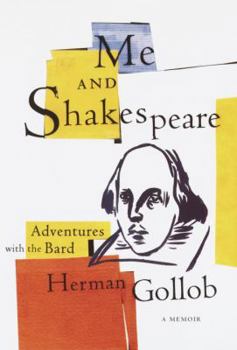
Me and Shakespeare: Life-Changing Adventures with the Bard

One man's post-retirement passion for the works of history's greatest literary genius becomes an inspiring intellectual and spiritual adventure--and a lesson in the ageless wisdom to be found in... This description may be from another edition of this product.
Format:Hardcover
Language:English
ISBN:0385498179
ISBN13:9780385498173
Release Date:April 2002
Publisher:Doubleday Religious Publishing Group, The
Length:352 Pages
Weight:1.35 lbs.
Dimensions:9.5" x 1.2" x 6.6"
Customer Reviews
4 ratings
A Pleasure to Read
Published by Thriftbooks.com User , 24 years ago
After reading "Me and Shakespeare" I feel as if Herman Gollob is an old friend. As a fellow auto-didact I can relate so well to all tat he has written. Those who have said that he is too self-absorbed or drops too many names are way off base. The fact that he was able to have contact with so many interesting people (Orson Welles is so much fun to read about), and not come across as a snob is very refreshing.This book is so much more upbeat, though Mr. Gollob does discuss some negative parts of his life, then "Shakespeare's Dresser". I would certainly put this one at the top of the list for fellow Bardologists. Maybe some day maybe we can expect a book from one of Mr. Gollob's friends entitled "Herman and Me". I think that would be a great read.For now let Mr. Gollob further stimulate your interest in WS.
Change as well as Shakespeare
Published by Thriftbooks.com User , 24 years ago
This is a powerful read, obviously about Shakespeare, as mentioned in above reviews, but as significantly, about a man's courage and willingness to change. I marvel that an age when many of his peers are fussing about their retirements homes and sore knees, Golob took on some very powerful changes -- religious, spiritual, and of course intellectual. The book shows us that it is never too late to change, to try new things, to embrace them with fervor and passion. I so admire Golob for this book, and (I am not a big Shakespeare) was genuinely shocked to find it so moving and relevant. Instead of succumbing to the first death -- when the mind closes and one begins whining about change -- Golob bravely reinvents and rediscovers himself. A really fine accomplishment, and a perfect gift for anyone veering close to mid-life and beyond.
The Best is Yet To Be
Published by Thriftbooks.com User , 24 years ago
The wonderfully unique book is best appreciated if you are Jewish, a senior citizen and/or a Shakespeare buff. Herman Gollob, recently retired from his editing chores at a publishing house, falls madly in love with Shakespeare. He rejects a retreat from societal intercourse and volunteers to teach a course on Shakespeare in the lifelong learning institute of a local college. There he finds an avocation and purpose that will carry him into his senior years.Gollob finds a love for research--both book-centered and travel-enhanced. He takes a three week course on the bard at Oxford where he does research in the august Bodleian Library. He dips his toes into the quiet purposefulness of the Folger Library in Washington, D.C. He attends a soul-inspiring performance of Hamlet at the newly rebuilt Globe Theater along the Thames in Southwark. He interviews actors and directos and watches them work. Along the way he enjoys the company of his elderhostel students. He recalls his feelings as a youngster in Texas and his rediscovery of his Jewishness. He ponders the process of aging and the place of oldsters in our society. He becomes clear that Shakespeare valued the heart and emotions much more than pure intellect. He imagines Shakespeare being influenced by a Jewish mentor most noticeably in the writing of King Lear. This odd conceit becomes oddly compelling as the book unfolds. Earlier I said you had to be a senior, Jewish or a Shakespeare buff to enjoy this book. Not really. I'm a little bit of two of these (pre-senior and former English teacher) and I liked this book a ton. Really what is needed is the ability to enjoy a character who brings a zest and a fervor to life. And Herman Gollob certainly does that.
A wonderful voyage to the planet Shakespeare
Published by Thriftbooks.com User , 24 years ago
She should have died hereafter;There would have been a time for such a word.To-morrow, and to-morrow, and to-morrow,Creeps in this petty pace from day to dayTo the last syllable of recorded time,And all our yesterdays have lighted foolsThe way to dusty death. Out, out, brief candle!Life's but a walking shadow, a poor playerThat struts and frets his hour upon the stageAnd then is heard no more: it is a taleTold by an idiot, full of sound and fury,Signifying nothing.--William Shakespeare, The Tragedy of Macbeth (Act V, sc. 5) Forget about those dusty tomes of academia, whose "jargon-burdened flights of hermeneutical ingenuity" induce terminal boredom. Me and Shakespeare is a triumph of communication. Herman Gollob is an amateur scholar of Shakespeare (in the best sense of the term amateur). Bubbling with life and vitality, bristling with wit and wisdom, his reader-friendly memoir is an impassioned celebration of genius--of an Elizabethan playwright, poet, and philosopher who is arguably the world's greatest writer. Gollob's magnificent obsession with the life and work of William Shakespeare began in a Broadway theatre, in which Gollob (now retired) witnessed a spirited and ingenious production of Hamlet starring Ralph Fiennes. This experience, he says, "galvanized me into a life-changing exploration of the planet Shakespeare." Like a Dostoyevskian character possessed and deranged by an ide'e fixe, Gollob plunged into a crash course on his new passion. Indeed, this volume should be titled A Passion for Shakespeare: Hermeneutical Musings of an Autodidact. Like everyone who approaches the Bard seriously, Gollob faced the problem, Where is Shakespeare coming from? What does he mean? How does one interpret him? Gollob's hermeneutical key was "seeing" Shakespeare from the perspective of Conservative Judaism. "The lens through which I discerned a crucial Shakespearean motif," he writes, "happened to be my religion." His antennae finely tuned from reading the Pentateuch (especially the Book of Genesis) and the Torah, his antennae couldn't help picking up the Judaic vibrations in a play such as King Lear. Gollob's point of view is interesting (there are many biblical allusions and themes in Shakespeare). However, from my own perspective as an amateur philosopher, I believe the recurring nihilistic sounds uttered by Shakespeare's characters suggest that he was an existential philosopher, not a biblical theologian. If Shakespeare tells us nothing else, Gollob asserts, it's that the human animal is a crazy patchwork of contradictions. The polyphonic range of Shakespeare's characters illustrate the divided nature of the soul, the inner struggle between the "heart "and the head," the spiritual and the sensual. Shakespeare was ever aware of the contradictions of the human comedy. Gollob points out that in Shakespeare's work, we should look, at all times, not for absolutes but for his "signature qualities": the ironies, ambiguities, paradoxes,
Copyright © 2026 Thriftbooks.com
Terms of Use | Privacy Policy | Do Not Sell/Share My Personal Information | Cookie Notice | Cookie Preferences | Accessibility Statement
ThriftBooks ® and the ThriftBooks ® logo are registered trademarks of Thrift Books Global, LLC
ThriftBooks ® and the ThriftBooks ® logo are registered trademarks of Thrift Books Global, LLC
