


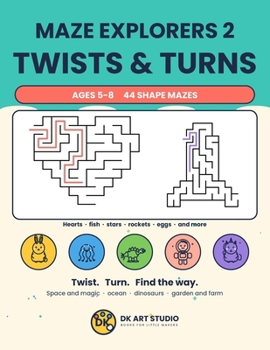
Maze Explorers 2: Twists & Turns

Forty-four mazes for children aged five to eight, each one carved inside a shape: a rocket, a heart, a fish, a turtle, a farmhouse, an egg. Twenty-five different shapes in all.
Why shapes make it trickierIn a square maze the walls run straight. In a shape maze the paths bend round the outline, squeeze through narrow parts and open out in wide ones, so a child has to look harder before they choose a way. It is the same pencil and the same rule, with more to think about.
Exactly one way throughEvery maze has one route from start to finish, and every route was checked by computer before it went to print. No maze with two answers. No maze with no answer.
Never easier than the last oneEach maze was measured for how long its route is and how many wrong turns it offers, then placed in order. Every maze is at least as tricky as the one before it. The first is about as hard as the middle of the first Maze Explorers book. The last is harder than anything in it.
A get-ready page for every mazeFacing each maze is a page that names the goal, shows the character and what they are looking for, gives a path to trace to warm the hand up, and leaves a box for inventing a maze of their own. The maze itself always sits on the right-hand page.
Forty-four shapes to find your way throughSpace and Magic -- a rocket, a moon, a flying saucer, a crown and a dragon egg
Ocean Deep -- a whale, a fish, a seashell, a turtle and a bubble
Dino Valley -- a nest, a snowman, a cave, a volcano rock and a dinosaur egg
Garden and Farm -- a flower, a cat face, a farmhouse and a cheese wheel
Built for small hands
Wide paths and thick lines, drawn for a fat pencil and a five-year-old grip. The narrowest path in the book is still almost a quarter of an inch across. A big 8.5 x 11 inch page, one maze to a page, and every answer in the back.
100 pages. Ages 5 to 8.
Book two of Maze Explorers, from DK Art Studio. Works on its own, and picks up where book one left off.
Customer Reviews
ThriftBooks ® and the ThriftBooks ® logo are registered trademarks of Thrift Books Global, LLC
