


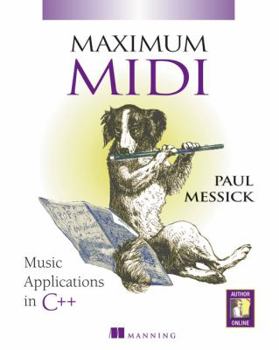
Maximum MIDI: Music Applications in C++

More than a dozen example programs, along with ToolKit's source code, gives programmers everything they need to develop music computer programs using Musical Instrument Digital Interface (MIDI).
Format:Paperback
Language:English
ISBN:1884777449
ISBN13:9781884777448
Release Date:August 1997
Publisher:Manning Publications
Length:479 Pages
Weight:1.80 lbs.
Dimensions:1.3" x 7.1" x 9.0"
Customer Reviews
5 ratings
Informative, Empowering, Amusing, Just plain good!
Published by Thriftbooks.com User , 25 years ago
First a note. The main purpose of this book is twofold. It's a good introduction to MIDI and using it in windows 95/98, but it doesn't go into detail of how windows does everything. Rather its a documentation for a library of functions that do all the hard work for you and let you get on with writing good MIDI applications. The source code is provided and the author leaves a VERY generous lisence on the software, allowing you to do nearly anything with it!Now a word on the writing. This book is perfect, the author uses subtle humor to keep the reading light, but not so much as to make it pathetic. He keeps the tone of the book informal, more as a friend explaining something than a professor lecturing. Despite being filled with facts and details and source code, the book reads like a novel. The chapter that simply describes an overview of the MIDI spec. makes for a great intro to MIDI, even for people who have been using it for years. If you ever plan on learning anything about MIDI and how to write computer programs that use it, buy this book.
Comment about thunking
Published by Thriftbooks.com User , 25 years ago
I've been reading through the MSDN Library documentation (available online if you want to look it up), and there's an article about MIDI timing (under Technical Articles/Multimedia) that specifically advocates using thunking on 95/98 platforms. NT doesn't have the same 32-bit latency issues, and their suggested solution to NT interoperability is to have both 16 and 32 bit DLLs, and switch between them based on OS.
A wonderful book
Published by Thriftbooks.com User , 27 years ago
I would have paid several hundred dollars for a library of C++ MIDI classes...you get them for free in this book. The author is an expert and the writing is clear easy to read. The book is a great resource if you want to learn how to program MIDI applications in C++.
The best in implementing MIDI with C++
Published by Thriftbooks.com User , 27 years ago
This book will precisely show you how to implement MIDI functionality using MFC and C++. The author knows his stuff and doesn't shy away from the subtleties of 16-bit thunking (to get the best timing) and other techniques necessary for the best results.As if that wasn't enough, you get a working toolkit of MFC C++ classes ready to implement in your own projects.
You use Windows? You want to USE MIDI? You want Maximum MIDI
Published by Thriftbooks.com User , 28 years ago
I hate computer books. They are all over two inches thick, and cost their weight in gold, but most of them are only worth their weight in paper. However, there is always an exception, and Paul Messick's 'Maximum Midi' is it. It's a GOOD book. You know, like Citizen Kane is a GOOD film. I can now write MIDI applications in Windows. I feel like a bit of an expert. My first sequencer already loads, saves, plays and records. I've got time to concentrate on making it highly usable. The author assumes that you or I, the reader, is intelligent. There's no assumption that you are a C++ whizz, or an electronics genius; just intelligent, and consequently ideas are explained from first principles by a writer who obviously knows his stuff well enough that he doesn't have to prove it by using long words and big ideas. But from first priciples comes lasting knowledge, and by the time the author moves on to explain the less pretty bits of MIDI implementation you realise that you UNDERSTAND everything that's gone before. The learning curve is so smooth, you don't realise you're climbing. But you are climbing, and quite rapidly at that. If ,like me, you read the book from cover to cover (some books just make you want to do that, don't they) by half-way through you KNOW what Sysex is, and how it works, and what's good about it, and why you have to be careful with it. You KNOW why Windows 95 makes timing algorithms difficult, and how to get around it. By this stage you also know that on the CD of the book, there is a toolkit. The toolkit contains functions that allow you to use MIDI in your programs, without also having to care about 'callbacks', 'thunks' or anything else that gives you a headache. (They are explained lucidly, but kept at a safe distance). Midi Input/Output, synchronisation and reading and writing of standard MIDI files are all introduced, fully explained and, finally, implemented in the toolkit. Although you now feel that could write your sequencer, or patch editor, or desk automator from the bottom up, it's nice to know you don't have to. The toolkit is there, it's tested, it works and it's royalty free. There is no reason not to use it. (It's provided as a pair of DLLs, so you can use it from any language. I'm now calling it from Delphi, and hardly knew what a DLL was before reading this book. A set of C++ classes encapsulate the toolkit's functions into a higher level, and very useful form). Don't you just loathe getting to page 800 of 'Mastering your Scroll-Lock key' and realising you learned as much from the introductory chapter as you have from the rest of the book. Well, Mr Messick's book (a mere 1.3 inches thick, if that's important to you!) is full of new knowledge from cover to cover, even the margins are sometimes used for 'by the way...' type information. For once, a publisher has realised that their readers are not fooled by the 'never mind the quality, feel the width' spin. Any useful book review has balance, so here it is: 'Silico
Copyright © 2026 Thriftbooks.com
Terms of Use | Privacy Policy | Do Not Sell/Share My Personal Information | Cookie Policy | Cookie Preferences | Accessibility Statement
ThriftBooks ® and the ThriftBooks ® logo are registered trademarks of Thrift Books Global, LLC
ThriftBooks ® and the ThriftBooks ® logo are registered trademarks of Thrift Books Global, LLC
