


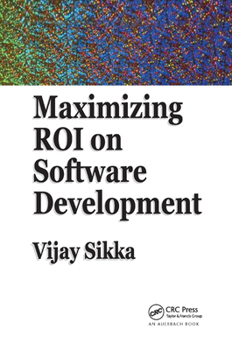
Maximizing ROI on Software Development


Select Format
Select Condition 
Book Overview
Maximizing ROI on Software Development serves as a guide for development teams. It reviews software development, tools, and methodologies, then examines how development, maintenance, and integration have become more complex and will continue to do so. The book discusses best practices for managing complexity and explores the business case for maximizing ROI. The text provides an analysis of ROI from several perspectives, covering nomenclature, project failure, mathematics, processes, work products, and techniques. It details how to make global teams successful and how to evaluate Applied ROI implementation, and it includes case studies for wireless, enterprise, and CRM systems.
Format:Paperback
Language:English
ISBN:0367393662
ISBN13:9780367393663
Release Date:December 2019
Publisher:Auerbach Publications
Length:280 Pages
Weight:0.85 lbs.
Dimensions:0.6" x 6.1" x 9.1"
Customer Reviews
2 ratings
Good ROI From this Book is Possible
Published by Thriftbooks.com User , 17 years ago
A review from my blog: In Maximizing ROI on Software Development, Vijay Sikka provides for those who lack it, a business perspective on software development. Chapter 1 - A Brief Review of Software Development History The first chapter is essentially a survey course in the ghosts of software methodologies past and present - from a light coverage of classic software development methodologies (such as waterfall and spiral) to a deeper coverage of evolving software methodologies (such as agile methodologies and model-driven architecture). Including a discussion of Web services development seemed a bit odd in the context of cataloging software methodologies, but the discussion is limited. Readers who are familiar with the popular assortment of software methodologies may find this chapter tedious. In my opinion, this chapter could've been an appendix. Chapter 2 - Software Complexity Crisis In this chapter (which I think would've made a better Chapter 1), Sikka paints the landscape of software development today with a focus on its growing complexity and challenges. He then considers the changing development landscape and how it necessitates a diversity in methodologies, technologies, and tools. He also acknowledges the growing dominance of .NET and J2EE for enterprise software development. Following a discussion of software maturity models, he then addresses the standard objections (excuses) people offer when the subject of software ROI is raised, and then discusses the benefits of software ROI analysis. The chapter ends with steps to prepare for an ROI analysis and a cautionary list of common mistakes. The last third of this chapter (section 2.4) is loaded with useful info and worthy of a second read. Chapter 3 - Software Development ROI While Chapter 2 ended with a brief intro to software ROI, Chapter 3 is where Sikka provides the details in what is a core chapter of this book. He devotes a hefty section each to baseline ROI and applied ROI. The section on applied ROI includes a discussion of TCO and how it factors into the puzzle. Towards the end of this section, the subject of software methodologies is woven back into the story and their value to ROI. The chapter ends with a discussion of those things that make ROI difficult to quantify. All in all, this chapter most closely met my expectations for this book. If you found yourself speeding through the first two chapters, you'll probably want to slow down when you reach this one to fully absorb it. Chapter 4 - The Case for Global Software Development and Testing This chapter pushes the reality that is global software development. After reading the last two chapters, it becomes more painfully obvious why companies are pursuing global solutions to the expense of software development. The author does not attempt to disguise his enthusiasm for offshore software development and testing. To those who have experienced the shifting of work offshore, this chapter will be a difficult one to embrace.
not just a narrow ROI text
Published by Thriftbooks.com User , 21 years ago
Sikka wants you to measure ROI on a software project that you manage. He explains that without a rigorous metric, how can you tell whether you are doing well or not? Accordingly and naturally, a lot of the book concerns how to measure ROI for a software team. But in doing so, Sikka broadens the scope of the book. He discusses how you might want to develop software using a globally dispersed team. Aha, offshoring, you think! Well, yes. But not purely to save money. He points out that if you have parts of the team throughout the world, then development can proceed on a 24 hour basis. He warns of the difficulties. This is definitely non-trivial to get right. But the payoff is quicker time to market, with development cost a secondary issue. Also, another advantage is that it tends to lead you to selling to a global market. If so, having your people in several countries can be invaluable in helping you be closer to those markets. Synergies to be reaped here.
Copyright © 2026 Thriftbooks.com
Terms of Use | Privacy Policy | Do Not Sell/Share My Personal Information | Cookie Notice | Cookie Preferences | Accessibility Statement
ThriftBooks ® and the ThriftBooks ® logo are registered trademarks of Thrift Books Global, LLC
ThriftBooks ® and the ThriftBooks ® logo are registered trademarks of Thrift Books Global, LLC
