


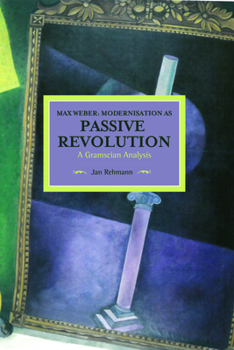
Max Weber: Modernisation as Passive Revolution: A Gramscian Analysis
(Book #82 in the Historical Materialism Series)
No Customer Reviews

Select Format
Select Condition 
Book Overview
With Gramsci's theory of hegemony as his starting point, this volume provides a comprehensive socio-analysis of Max Weber's political and intellectual position in the ideological network of his time. Rehmann lucidly and witheringly argues that, even though Weber presents his science as'value-free, ' the forefather of sociology's system is best understood as an organic intellectual of the bourgeoisie advocating for a new model of capitalist hegemony.
Format:Paperback
Language:English
ISBN:1608465519
ISBN13:9781608465514
Release Date:December 2015
Publisher:Haymarket Books
Length:435 Pages
Weight:1.35 lbs.
Dimensions:1.0" x 6.0" x 9.0"
Related Subjects
Philosophy Political Science Politics & Social Sciences Social Science Social SciencesCustomer Reviews
0 rating
Copyright © 2026 Thriftbooks.com
Terms of Use | Privacy Policy | Do Not Sell/Share My Personal Information | Cookie Policy | Cookie Preferences | Accessibility Statement
ThriftBooks ® and the ThriftBooks ® logo are registered trademarks of Thrift Books Global, LLC
ThriftBooks ® and the ThriftBooks ® logo are registered trademarks of Thrift Books Global, LLC
