


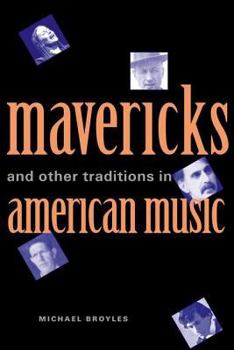
Mavericks and Other Traditions in American Music

Select Format
Select Condition 
Book Overview
From colonial times to the present, American composers have lived on the fringes of society and defined themselves in large part as outsiders. In this stimulating book Michael Broyles considers the... This description may be from another edition of this product.
Format:Hardcover
Language:English
ISBN:0300100450
ISBN13:9780300100457
Release Date:May 2004
Publisher:Yale University Press
Length:400 Pages
Weight:1.58 lbs.
Dimensions:9.3" x 0.8" x 6.3"
Customer Reviews
1 rating
"Who Cares If You Listen?"
Published by Thriftbooks.com User , 21 years ago
This quote, attributed to Milton Babbitt in his 1958 High Fidelity magazine article "The Composer as Specialist," sits in the middle of this intriguing book by Michael Broyles. Never mind that this was more editorial license than Babbitt, and that it haunted Babbitt forevermore. It conveniently divides Broyles's book into two unequal chronological parts: The "before," when composers were mavericks out of necessity, and the "after," when it seemed that every composer in a new aesthetic but not a serialist was saying "I want to be an American maverick too!" Put briefly, this book is all about "unorthodoxy" amongst American composers from Colonial times to today. It is well-written by Broyles, an expert on the history of American classical music and its relationship with culture and society. Nearly 250 years of unorthodoxy in American music is a huge subject, and Broyles does well by it, if not quite to the extent suggested by the dust jacket blurbs. But that's a matter of the size of the assignment. Without highlighting some mavericks at the expense of others (and some interesting ones have been overlooked), this book would have been much larger. As it is, there is no shortage of material to hold one's interest. Broyles covers the beginnings of American music with two early mavericks: William Billings in the Colonial era and Anthony Philip Heinrich in the decades prior to the Civil War. Both were mavericks by being composers when this was hardly a socially-acceptable endeavor. Both were self-taught and radical for their time. Billings is remembered for his hymnody. Heinrich is barely remembered at all, but in some respects was a precursor to Louis Moreau Gottschalk, Stephen Foster and Charles Ives. The post-Civil War decades of the 19th century largely get glanced over; these decades were hard times for this maverick tradition: The establishment of symphony orchestras in America during this period, led by European conductors, marked a sea change toward European - or at least European-influenced - art music. Broyles conveniently divides the 20th century in half: "before" and "after" the "tyranny of serialism" that took hold at mid-century. The first two decades were dominated by two mavericks: Charles Ives, the private composer who waited decades for much of his music to be performed, and Leo Ornstein, the Russian firebrand, newly in America and concertizing with his dissonant keyboard compositions. The 1920s roared with the ultramodernist movement, including Edgard Varèse, Carl Ruggles, Charles Seeger, Ruth Crawford, Henry Cowell, George Antheil, and even Aaron Copland in his formative years. Much of this ultramodernist "outbreak" took place in the brief 1922 - 1926 period, which Broyles calls American music's Cambrian Explosion. The ultramodernists didn't find public audiences for their radical music, so they simply did what the serialists were to do three decades later: They became their own community audience (enhanced by a few brave souls l
Copyright © 2026 Thriftbooks.com Terms of Use
| Privacy Policy | Do Not
Sell/Share My Personal Information | Cookie Policy | Cookie Preferences | Accessibility Statement
ThriftBooks® and the ThriftBooks® logo are registered trademarks of Thrift Books Global, LLC
ThriftBooks® and the ThriftBooks® logo are registered trademarks of Thrift Books Global, LLC
