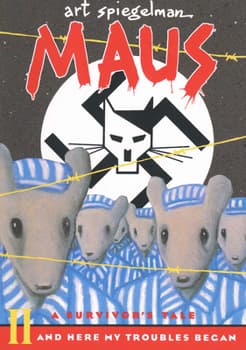
The bestselling first installment of the graphic novel acclaimed as "the most affecting and successful narrative ever done about the Holocaust" (Wall Street Journal) and "the first masterpiece in comic book history" (The New Yorker) - PULITZER PRIZE WINNER - One of Variety's "Banned and Challenged Books Everyone Should Read" A brutally moving work of art--widely hailed as the greatest graphic novel ever written--Maus recounts the chilling experiences of the author's father during the Holocaust, with Jews drawn as wide-eyed mice and Nazis as menacing cats. Maus is a haunting tale within a tale, weaving the author's account of his tortured relationship with his aging father into an astonishing retelling of one of history's most unspeakable tragedies. It is an unforgettable story of survival and a disarming look at the legacy of trauma.
A great book for teens or young adults who may just be learning about the holocaust. Graphic but not gory. Heartbreaking but inspiring!
1
★★★★☆
Very insightful
By AwkwardBadger, May 25, 2025
Verified Purchase
Spiegelman tells his parents story about the holocaust from his father's perspective, and gives a glimpse into the life his father lives now and the relationship they have.
2
★★★★★
Good history lesson
By LNorton, December 20, 2022
Verified Purchase
I think this little comic is great for those who want to learn about the Holocaust. It offers an interesting perspective and really makes you think.
5
★★★★★
Great Read
By Thriftbooks.com User, March 27, 2018
Verified Purchase
Loved the artwork and story. Very interesting and informative graphic novel about Nazi Concentration Camps. Would definitely recommend. Great for high school classrooms!
9
★★★★★
Explanation of the Animal Portrayals
By Thriftbooks.com User, November 7, 2001
As a history and literature major, I wrote my senior thesis on Maus and Maus II because, after reading them for a class, I couldn't stop thinking about them. The imagery, both drawn and implied, was masterful. Each panel tells the story of the Holocaust as SOMEONE REMEMBERS IT. Spiegelman took his father's story and graphically interpreted it in an incredibly moving way. He did not write a work of historical fact (for whatever those books are worth anyway - even history is a work of memory and interpretation). I love these graphic novels for what they are - brilliant literature and testimony.I was looking over some of these reviews of Maus because I am going to see Spiegelman speak this weekend and just wanted to know what others had said in the past. I was disheartened to read some of the negative responses to the use of animal caricatures, especially since I have always felt this was the most ingenius part of the works. Looking at these reviews, though, I remembered an interview with Spiegelman I read a while back. He explains the animal caricatures a bit, and I thought it might be beneficial to place a quote here, in this forum.Published in The Comics Journal, October 1991:Spiegelman says of the animal portrayals, "These images are not my images. I borrowed them from the Germans. At a certain point I wanted to go to Poland, and I had to get a visa. I put in my application, and then I got a call from the consul. He said 'the Polish attache wants to speak with you.' And I knew what he wanted to talk to me about. On the way over there, I tried to figure out what I was going to say to him. 'I wanted to draw noble stallions, but I don't do horses very well?' When I got there, he gave me the perfect opening. He said, 'You know, the Nazis called us schwein' (German for pig). And I said, 'Yes, and they called us vermin (German for mouse or rat).' Ultimately, what the book is about is the commonality of human beings. It's crazy to divide things down the nationalistic or racial or religious lines. And that's the whole point, isn't it? These metaphors, which are meant to self-destruct in my book - and I think they do self-destruct - still have a residual force that allows them to work as metaphors, and still get people worked up over them."I guess he's right. People do get worked up over the metaphors. Too bad some of those people can't understand them. If you haven't read Maus, you are missing a true piece of art.
22
★★★★★
Ignore the ramblings of the PC watchdog reviewers.
By Thriftbooks.com User, June 30, 2001
First of all, if you've read or are reading the other reviews, ignore the blather about how the whole "Animal Farm" metaphor--Jews as mice, Germans as cats, etc..--being racist and demeaning.Art Spiegelman attempts to tell the story of his father Vladek's life in Hitler's Europe. By and large, the book is a detailed, objective retelling of his Vladek's story. However, as Art himself will realize, "I can't even make sense out of my relationship with my father--how am I supposed to make sense out of the Holocaust?" and "Reality is much too complex for comics--so much has to be left out or distorted." Thus liberated from the impossible standard of complete objectivity, Art is free to insert two important subjective elements into the story--the depiction of different races as different species, and the insertion of himself as a character in MAUS.Obviously, Art is not a overt racist--in fact, in the second part of MAUS, Art will scold his father for distrusting a black person, and a German-Jewish couple will help Vladek return home after being freed from the death camps. The point of portraying Jews as mice, Germans as cats, Poles as pigs, etc. is to show what race relations during Hitler's Europe might have been like.The characterization of race doesn't end there, though--as the scene shifts from Nazi Germany to the present, and as Art must suffer the daily trials and tribulations of life with a father permanently scarred by his experiences, Art depicts himself as a mouse as well, a confession that he himself is unable to completely escape the aftermath of the poisoned race relations of the Holocaust. Maybe this makes him a covert racist. But if he is, then who isn't?Art's involvement in MAUS goes beyond interviewing his father, though. Later in the story we will see that Art was treated in a mental hospital and sees a psychiatrist regularly. As the book cover declares, "MAUS is a story about the survivors of the Holocaust--and of the children who somehow survive the survivors."The storytelling in MAUS is stellar, and the craftsmanship is as well. The comics medium allows Spiegelman to employ some interesting tricks. For example, whenever Vladek is trying to sneak around, he is portrayed with a pig mask. When Vladek and Anja are trying to escape from the ghetto, Anja, who in real life was easily identifiable as a Jew by her appearance, is drawn with a long tail, while Vladek is not.In sum, MAUS is a gripping story of his parents' experience during the Holocaust, filled with countless brushes with death, tales of betrayal, and plenty of terrible, graphic illustrations of victims being executed. It is not a history text in the most austere and empirical sense. Rather, it is a confession that the Holocaust defies dispassionate and detached analysis.
7
Maus: A Survivor's Tale: My Father Bleeds History Mentions in Our Blog
Comic books aren't all superheroes and dystopian fantasy. Here are ten gorgeous graphic novels featuring powerful storylines that are complex, emotional, and educational.