


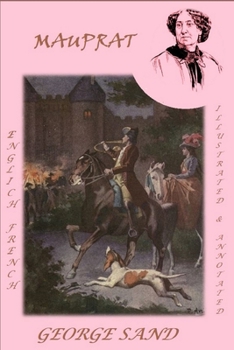
MAUPRAT (Illustrated & Annotated): Bilingual Edition - English / French
No Customer Reviews

In this New Bilingual Edition of "Mauprat" by George Sand:
- English Version translated by John Oliver Hobbes (Pearl Mary Teresa Craigie).from 1904 edition. Illustrated by Eugene Paul Avril with three, coloured plates after water-colour drawings.
-Following by "The Portraits of George Sand" by Octave Uzanne, with illustrations.
-French 1837 Original Version, illustrated by Tony Johannot for the 1852 edition. "Mauprat" is a novel by the French novelist George Sand about love and education. It was published in serial form in April and May 1837. Like many of Sand's novels, Mauprat borrows from various fictional genres - the Gothic novel, chivalric romance, the Bildungsroman, detective fiction and the historical novel.
The novel's plot has been called a plot of female socialization, in which the hero is taught by the heroine how to live peacefully in society. Mauprat resembles the fairy tale "Beauty and the Beast". As this would suggest, the novel is a romance. However, Sand resists the immediate happy ending of marriage between the two main characters in favor of a more gradual story of education, including a reappraisal of the passive female role in courtship and marriage. Sand also calls into question Rousseau's ideal version of the female education as described in his novel Emile, namely, training women for domesticity and the home.
The novel, set before the French Revolution, depicts the coming of age of a nobleman named Bernard Mauprat. The story is narrated by the old Bernard in his country home many years later, as told to a nameless young male visitor. Bernard recounts how, raised by a violent gang of his feudal kinsmen after the death of his mother, he becomes a brutalized "enfant sauvage". When his cousin Edm?e is held captive by Bernard's "family", he helps her escape, but elicits a promise of marriage from her by threatening rape. Thus begins the long courtship of Bernard and Edm?e. The novel ends with a dramatic trial scene, similar to that in Stendhal's The Red and the Black.
During the period Sand wrote the novel, she was gradually becoming more interested in the problem of political equality in society. She had read widely about the views of socialist thinkers such as Pierre Leroux, with whom she went on to form a journal, the Revue Ind?pendante. In keeping with Sand's interest in equality, Mauprat depicts a new type of literary figure, the peasant visionary Patience. In addition, part of the novel takes place during the American Revolutionary War. Amantine Lucile Aurore Dupin (1 July 1804 - 8 June 1876), best known by her nom de plume George Sand, was a French novelist, memoirist, and socialist. One of the most popular writers in Europe in her lifetime, being more popular than both Victor Hugo and Honor? de Balzac in England in the 1830s and 1840s, Sand is recognised as one of the most notable writers of the European Romantic era. In the same bilingual edition from G. Sand, see also:
INDIANA
THE DEVIL'S POOL
CONSUELO
- English Version translated by John Oliver Hobbes (Pearl Mary Teresa Craigie).from 1904 edition. Illustrated by Eugene Paul Avril with three, coloured plates after water-colour drawings.
-Following by "The Portraits of George Sand" by Octave Uzanne, with illustrations.
-French 1837 Original Version, illustrated by Tony Johannot for the 1852 edition. "Mauprat" is a novel by the French novelist George Sand about love and education. It was published in serial form in April and May 1837. Like many of Sand's novels, Mauprat borrows from various fictional genres - the Gothic novel, chivalric romance, the Bildungsroman, detective fiction and the historical novel.
The novel's plot has been called a plot of female socialization, in which the hero is taught by the heroine how to live peacefully in society. Mauprat resembles the fairy tale "Beauty and the Beast". As this would suggest, the novel is a romance. However, Sand resists the immediate happy ending of marriage between the two main characters in favor of a more gradual story of education, including a reappraisal of the passive female role in courtship and marriage. Sand also calls into question Rousseau's ideal version of the female education as described in his novel Emile, namely, training women for domesticity and the home.
The novel, set before the French Revolution, depicts the coming of age of a nobleman named Bernard Mauprat. The story is narrated by the old Bernard in his country home many years later, as told to a nameless young male visitor. Bernard recounts how, raised by a violent gang of his feudal kinsmen after the death of his mother, he becomes a brutalized "enfant sauvage". When his cousin Edm?e is held captive by Bernard's "family", he helps her escape, but elicits a promise of marriage from her by threatening rape. Thus begins the long courtship of Bernard and Edm?e. The novel ends with a dramatic trial scene, similar to that in Stendhal's The Red and the Black.
During the period Sand wrote the novel, she was gradually becoming more interested in the problem of political equality in society. She had read widely about the views of socialist thinkers such as Pierre Leroux, with whom she went on to form a journal, the Revue Ind?pendante. In keeping with Sand's interest in equality, Mauprat depicts a new type of literary figure, the peasant visionary Patience. In addition, part of the novel takes place during the American Revolutionary War. Amantine Lucile Aurore Dupin (1 July 1804 - 8 June 1876), best known by her nom de plume George Sand, was a French novelist, memoirist, and socialist. One of the most popular writers in Europe in her lifetime, being more popular than both Victor Hugo and Honor? de Balzac in England in the 1830s and 1840s, Sand is recognised as one of the most notable writers of the European Romantic era. In the same bilingual edition from G. Sand, see also:
INDIANA
THE DEVIL'S POOL
CONSUELO
Format:Paperback
Language:English
ISBN:B08ZBPK86R
ISBN13:9798724128322
Release Date:January 1
Publisher:Independently Published
Length:648 Pages
Weight:2.62 lbs.
Dimensions:1.7" x 6.0" x 9.0"
Customer Reviews
0 rating
Copyright © 2026 Thriftbooks.com Terms of Use
| Privacy Policy | Do Not
Sell/Share My Personal Information | Cookie Policy | Cookie Preferences | Accessibility Statement
ThriftBooks® and the ThriftBooks® logo are registered trademarks of Thrift Books Global, LLC
ThriftBooks® and the ThriftBooks® logo are registered trademarks of Thrift Books Global, LLC
