


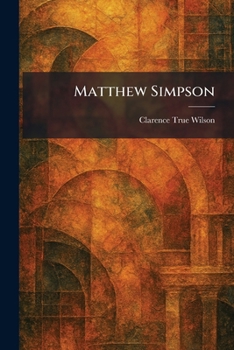
Matthew Simpson

Select Format
Select Condition 
Book Overview
"Matthew Simpson" provides a comprehensive biographical study of one of the most influential religious figures in nineteenth-century America. Written by Clarence True Wilson, this work explores the life and legacy of Bishop Matthew Simpson, a preeminent leader of the Methodist Episcopal Church whose impact extended far beyond the pulpit. The narrative traces Simpson's rise to prominence, highlighting his exceptional skills as an orator, educator, and ecclesiastical statesman.
A central focus of the work is Simpson's significant role during the American Civil War and his close relationship with President Abraham Lincoln. As a trusted advisor to the President, Simpson played a pivotal part in shaping national sentiment and providing spiritual counsel during the country's most turbulent era. The book details his contributions to the development of Methodist institutions and his unwavering commitment to social and political causes, including the abolition of slavery. Readers will gain insight into the character of a man who combined deep religious conviction with a keen understanding of the American political landscape. This biography serves as an essential resource for those interested in the history of American Methodism, the intersection of religion and politics, and the life of a transformative figure in the nineteenth century.
This work has been selected by scholars as being culturally important, and is part of the knowledge base of civilization as we know it. This work was reproduced from the original artifact, and remains as true to the original work as possible. Therefore, you may see the original copyright references, library stamps (as most of these works have been housed in our most important libraries around the world), and other notations in the work.
This work is in the public domain in the United States of America, and possibly other nations. Within the United States, you may freely copy and distribute this work, as no entity (individual or corporate) has a copyright on the body of the work.
As a reproduction of a historical artifact, this work may contain missing or blurred pages, poor pictures, errant marks, etc. Scholars believe, and we concur, that this work is important enough to be preserved, reproduced, and made generally available to the public. We appreciate your support of the preservation process, and thank you for being an important part of keeping this knowledge alive and relevant.
Customer Reviews
ThriftBooks ® and the ThriftBooks ® logo are registered trademarks of Thrift Books Global, LLC
