


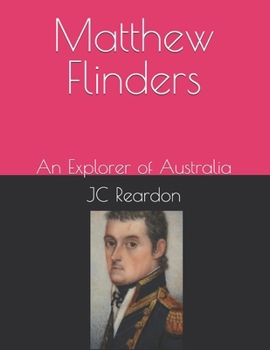
Matthew Flinders: An Explorer of Australia

Early Life and Background (1774-1794)
Matthew Flinders was born on March 16, 1774, in Donington, Lincolnshire, England. He was the son of Matthew Flinders Sr., a surgeon, and Susannah Ward. From a young age, Flinders was inspired by the adventures of Captain James Cook and was drawn to the idea of maritime exploration.
At the age of 15, he joined the Royal Navy as a midshipman on October 23, 1789, serving under Captain Thomas Pasley. His early naval training prepared him for his future career in exploration and cartography.
Early Naval Career and First Voyage to Australia (1794-1800)Flinders' first significant naval service was aboard HMS Providence under Captain William Bligh (famous for the mutiny on the Bounty). This gave him valuable experience in navigation and mapping.
In 1795, Flinders joined HMS Reliance, captained by Henry Waterhouse, and set sail for the new British colony of New South Wales. On this journey, he befriended George Bass, a naval surgeon with whom he would later explore the coastline of Australia.
Between 1796 and 1798, Flinders and Bass undertook several expeditions along the Australian coast, using a small open boat named Tom Thumb. Their 1798 expedition confirmed that Tasmania (then called Van Diemen's Land) was an island, separate from mainland Australia. This led to the opening of the Bass Strait, an important shipping route.
Circumnavigation of Australia (1801-1803)Flinders' most significant achievement was the first circumnavigation of Australia, proving that it was a single continent.
Command of HMS Investigator: In 1801, the British Admiralty gave Flinders command of HMS Investigator and tasked him with mapping the coastline of "New Holland" (as Australia was then known).
Expedition Begins: Flinders set sail from England in July 1801, accompanied by botanist Robert Brown and a skilled crew.
Coastal Mapping: Between 1801 and 1803, Flinders meticulously charted the southern, western, and northern coasts of Australia, improving navigation and providing a more accurate understanding of the continent.
Encounter with Nicolas Baudin: While exploring, he encountered French explorer Nicolas Baudin at what is now Encounter Bay, South Australia, in 1802. Though their countries were at war, the meeting was peaceful.
Imprisonment on Mauritius (1803-1810)On his return journey to England in 1803, Flinders was forced to stop at the French-controlled island of Mauritius (then called Isle de France) due to a damaged ship. He carried British naval papers, which raised French suspicions, and he was imprisoned by the French governor, Charles Decaen, for over six years (1803-1810).
Later Years and Death (1810-1814)
After returning to England in 1810, Flinders focused on compiling his extensive maps and writings. His landmark book, "A Voyage to Terra Australis," along with detailed maps of the Australian coastline, was published on July 18, 1814-just one day before his death.
Matthew Flinders died on July 19, 1814, at the age of 40, likely due to kidney disease. He was buried in London at St. James's Cemetery, but his grave was lost over time. In 2019, his remains were rediscovered during construction work at Euston Station.
Related Subjects
HistoryCustomer Reviews
ThriftBooks® and the ThriftBooks® logo are registered trademarks of Thrift Books Global, LLC
