


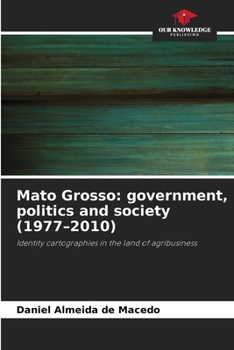
Mato Grosso: government, politics and society (1977-2010)
No Customer Reviews

This historiographical work presents a parallel and comparative account of government actions, political activity, and the profile of society in the northern and southern regions of the state of Mato Grosso do Sul in the years leading up to its division in 1977 and in the post-division period until 2010. In its initial part, the research reveals that, since the establishment of the New State, the authoritarian government promoted the occupation of 'empty spaces' in the interest of national security and allied its 'Brazil Power' project with the interests of the agrarian elite of Mato Grosso do Sul, which decisively drove the breakup of the state. The second part of the thesis analyses the construction of the multifaceted identity of the contemporary people of Mato Grosso, formed and transformed by the new territorialisations. In its final stage, the research examines socioeconomic vectors and demonstrates that between the last quarter of the 20th century and the early years of the 21st century, regional economic evolution in Mato Grosso resulted from an unbalanced developmental model, which remains heterogeneous, with the coexistence of 'islands' of growth and areas with reduced prospects for development.
Format:Paperback
Language:English
ISBN:6209403565
ISBN13:9786209403569
Release Date:January 2026
Publisher:Our Knowledge Publishing
Length:208 Pages
Weight:0.63 lbs.
Dimensions:0.5" x 6.0" x 9.0"
Related Subjects
HistoryCustomer Reviews
0 rating
Copyright © 2026 Thriftbooks.com
Terms of Use | Privacy Policy | Do Not Sell/Share My Personal Information | Cookie Notice | Cookie Preferences | Accessibility Statement
ThriftBooks ® and the ThriftBooks ® logo are registered trademarks of Thrift Books Global, LLC
ThriftBooks ® and the ThriftBooks ® logo are registered trademarks of Thrift Books Global, LLC
