


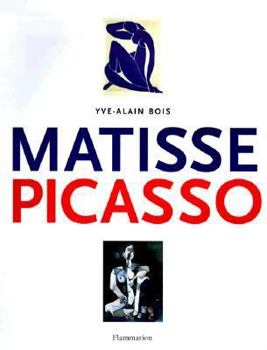
Matisse And Picasso

Select Format
Select Condition 
Book Overview
Fiercely competitive yet amicable, Matisse and Picasso engaged in one of the most formidable artistic dialogues of this century -- from the time they met in 1906 until Matisse's death in 1954.
Format:Hardcover
Language:English
ISBN:2080135481
ISBN13:9782080135483
Release Date:January 1999
Publisher:Flammarion et Cie
Length:271 Pages
Weight:1.25 lbs.
Dimensions:11.1" x 1.1" x 9.4"
Customer Reviews
2 ratings
Dialogue--not clash--of the titans
Published by Thriftbooks.com User , 27 years ago
This nimble and witty book by one of the most important scholars of modern art is not merely the sum of two monographs on these giants of the 20th century. To the now-standard operating procedure of relativism and contextualization, Bois adds a twist. He proposes the relationship between the artists as a fitful but sustaining dialogue, rejecting as inadequate to the critical task the idea that Matisse and Picasso simply influenced one another. Drawing on diverse theoretical models in the writing of Mikhail Bakhtin, Hubert Damisch, Rene Girard and Harold Bloom, the author argues instead that for a period of over 25 years, from the late 1920s until after Matisse's death in 1954, each artist deliberately addressed his work in specific ways to the other. The theory is necessary because actual contact between the two was sporadic. This is what makes Bois's thesis about their need for one another so intriguing. What prompted this dialogue--what made the need possible, Bois asserts--was their common cause against abstraction. Prodding, teasing, paying homage, supplicating, even misunderstanding--in these and other ways Matisse and Picasso challenged each other in their mutual effort to push the envelope of representation without letting the tangibility of the world's things slip from their grasp. When they strayed into the other's long-established artistic territories (Picasso painting odalisques; Matisse working in a Cubist idiom) they were sending signals to each other above the artistic fray, in a kind of Olympian fraternal sympathy. This sealing off of Matisse's and Picasso's artistic communication from the rest of the world is the most controversial aspect of the book, as it was of the beautiful exhibition it accompanied at the Kimbell Art Museum in Fort Worth, Texas. Bois frankly calls his effort an "experiment" in which it is necessary to isolate variables, studying them carefully in relation to one another, with the relationship itself as the constant factor. This scientific conceit of "let's see what happens" is undermined by the humanistic drive to demonstrate a thesis. And we should be thankful for that. Like the best publications arising from exhibitions, this book will have independent, lasting value, but it will also be more provocative than most.
An extraordinary catalogue for an unusual exhibition
Published by Thriftbooks.com User , 27 years ago
Some might say that another exhibition of Matisse and Picasso is hardly what the art world needs. Havent't we seen enough of these two artists recently? Why continue to do blockbuster exhibitions which just show us well-known works? If you read this book, you might change your mind about the relevance of the show. First, although some of the paintings shown here are quite familiar from other exhibitions, many have never been exhibited or published before. Second, this exhibition offers a rare look at a virtually unique case of two major artists who visibly responded to each other's styles during 25 years of peak productivity. The book focusses on the 1930's, '40's and early 1950's (the section on the war years is particularly well-written), and allows the reader to experience, virtually month by month, the artistic interaction between the two artists. It is fascinating to see the commonality in their themes, beliefs and motifs, despite the great difference in their visual styles. Finally, this is a well-designed book - the plates are of the highest color quality and are beautifully arranged. Although English is not Bois' first language, the text has been translated in an elegant and efficient manner. If you can't go see this exhibition, definitely read this book.
Copyright © 2026 Thriftbooks.com
Terms of Use | Privacy Policy | Do Not Sell/Share My Personal Information | Cookie Notice | Cookie Preferences | Accessibility Statement
ThriftBooks ® and the ThriftBooks ® logo are registered trademarks of Thrift Books Global, LLC
ThriftBooks ® and the ThriftBooks ® logo are registered trademarks of Thrift Books Global, LLC
