


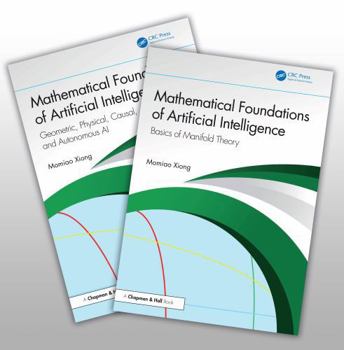
Mathematical Foundations of Artificial Intelligence: Two Volume Set

Mathematical Foundations of Artificial Intelligence: Two Volume Set addresses the mathematical foundations essential for modern artificial intelligence, establishing a unified framework based on smooth manifold theory and Riemannian geometry. It explores how differential geometry provides a coherent language for representing, analyzing, and integrating AI systems across deep learning, generative modeling, physical AI, biological systems, and autonomous reasoning.
The books define AI as a geometry-driven discipline and investigate the role of manifolds as natural domains for data representation and intelligent computation. Volume One develops core concepts--topological and smooth manifolds, Riemannian metrics, differential forms, Lie derivatives, and statistical geometry--while providing step-by-step applications to data science, genomics, drug discovery, and AI-driven systems. Volume Two reconstructs AI around four foundational pillars: geometry, physics, causality, and autonomy. It introduces the physical transformer, interprets neural computation through Hamiltonian mechanics and optimal control, extends geometric methods to single-cell biology and RNA velocity, and develops spatial intelligence that integrates perception, reasoning, and control. The volumes comment on the benefits and limitations of geometric approaches across different AI paradigms and remark on the advantages and disadvantages of various mathematical frameworks.
This set consists of 15 chapters and is an excellent reference for graduate students, researchers, academics, and professionals in statistics, mathematics, computer science, AI, physics, bioinformatics, and biomedical sciences.
Key Features
- Establishes a unified geometric framework spanning AI theory, biological systems, robotics, and physical modeling across both volumes
- Develops innovative architectures including Lie derivative-aware neural networks, physical transformers, and mechanics-omics coupled models
- Bridges abstract manifold theory with practical algorithms for generative models, graph learning, molecular property prediction, and disease gene identification
- Integrates Hamiltonian mechanics, optimal control, and causal reasoning into modern AI design and autonomous decision-making
- Applies geometric methods to cutting-edge applications: single-cell RNA velocity, tumor cell localization, drug discovery, and spatial intelligence
- Features step-by-step examples, case studies, and visual explanations designed for self-study and AI-assisted learning
Recommended
Format: Misc.

Customer Reviews
ThriftBooks ® and the ThriftBooks ® logo are registered trademarks of Thrift Books Global, LLC
