


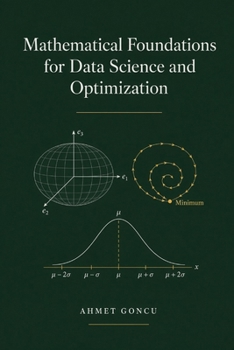
Mathematical Foundations for Data Science and Optimization

The math that actually powers machine learning - explained once, correctly, and paired with code you can run.
Most students learn linear algebra, calculus, probability, and optimization as four separate, disconnected courses - then struggle to see how any of it actually shows up in a gradient descent update, a covariance matrix, or a neural network's backward pass.
Mathematical Foundations for Data Science and Optimization closes that gap: a single, rigorously written volume that builds the mathematics from first principles and shows, at every step, exactly how it translates into working Python.This book covers:
Linear Algebra - systems of equations, matrix operations, vector spaces, eigenvalues and eigenvectors, and the decompositions (LU, QR, Cholesky, SVD) that make modern computation possible, culminating in a full derivation of Principal Component Analysis.
Calculus - derivatives, partial derivatives, gradients, Jacobians, and Hessians, chain rule and Taylor expansion, built specifically toward the multivariable optimization that machine learning depends on.
Probability - axioms, conditional probability and Bayes' theorem, random variables, expectation, and the distributions that matter in practice, including the Normal and Student's t-distributions with real simulated data and fitted density plots.
Nonlinear Optimization - gradient descent, Newton's method, and stochastic gradient descent, with convergence theory made concrete through worked examples and real generated figures, not just abstract bounds.
What sets this book apart:
Every theorem is followed by a fully worked, step-by-step example - no results are left unillustratedEvery chapter includes runnable Python code (NumPy, SciPy, scikit-learn, Matplotlib)
Whether you're a student preparing for a machine learning course, a self-taught engineer filling gaps in your mathematical foundation, or an instructor looking for a single reference that unifies these four subjects, this book is designed to be worked through, not just read - a desk reference you'll return to long after the first pass.
Customer Reviews
ThriftBooks ® and the ThriftBooks ® logo are registered trademarks of Thrift Books Global, LLC
