


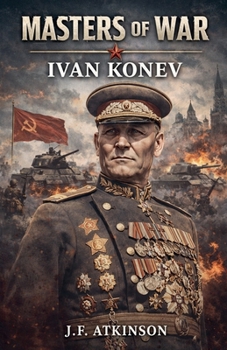
Masters of War: Ivan Konev

Masters of War: Ivan Konev
A Detailed Account of the Life and Military Conquests of One of World War II's Greatest Commanders
From the frozen fields of northern Russia to the ruins of Berlin, Ivan Stepanovich Konev's journey embodied one of the most remarkable transformations in military history. Born into peasant poverty in 1897, he rose to command over a million soldiers in some of World War II's most decisive battles, helping to change the course of human history.
Masters of War: Ivan Konev provides the first comprehensive English-language examination of the Soviet marshal who liberated Eastern Europe, raced Zhukov to Berlin, and demonstrated operational brilliance that placed him among the twentieth century's premier military commanders. This detailed study examines Konev's life and campaigns with analytical rigor, focusing on his evolution as a commander, his operational methods, and his contributions to defeating Nazi Germany.
A Journey from Disaster to Triumph
Konev's wartime career began with catastrophe. In October 1941, his forces were encircled at Vyazma in one of the war's worst disasters, with hundreds of thousands of Soviet soldiers killed or captured. Konev faced execution, a fate from which only Georgy Zhukov's intervention saved him. From this nadir, he rebuilt his career through determination, adaptability, and increasingly sophisticated understanding of modern warfare.
The book traces Konev's evolution through the grinding defensive battles of 1941-1942, the turning point at Kursk in 1943, and the great offensive operations of 1944-1945 that drove German forces from Soviet territory into Germany itself. His campaigns, the Lvov-Sandomierz Offensive, the spectacular Vistula-Oder advance covering 300 miles in three weeks, the race to Berlin, and the liberation of Prague showcased operational art at its most sophisticated.
Ivan Konev's journey from peasant to marshal, from disaster at Vyazma to triumph in Berlin, from wartime glory to Cold War controversies, illuminates both the possibilities and costs of the Soviet experience. His operational achievements contributed decisively to defeating Nazi Germany. His service to Stalin's system involved moral compromises that complicate simple celebration of those achievements.
Masters of War: Ivan Konev provides the comprehensive, balanced assessment this significant commander deserves, recognizing his military excellence while acknowledging historical complexities, studying his methods while understanding their context, and offering lessons for contemporary military professionals while situating them in their historical moment.
For anyone seeking to understand World War II's Eastern Front, the development of modern operational warfare, or the nature of military leadership under extreme circumstances, this book provides essential reading. Konev's story deserves to be known, not as propaganda for any cause, but as honest history that recognizes both human capability at its most impressive and the moral complexities that warfare inevitably creates.
Customer Reviews
ThriftBooks® and the ThriftBooks® logo are registered trademarks of Thrift Books Global, LLC
