


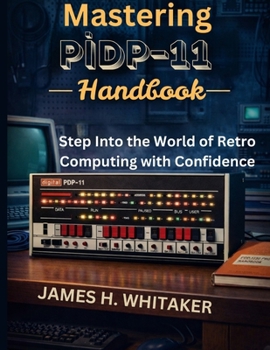
Mastering PiDP-11 Handbook: Step Into the World of Retro Computing with Confidence

Have you ever wondered what it really felt like to stand in front of a classic minicomputer, flip physical switches, watch rows of blinking lights, and control a machine at the most fundamental level?
Have you ever asked yourself how operating systems like UNIX were born... how programmers wrote code before modern IDEs... how computers actually execute instructions beneath today's polished interfaces?
What if you could experience all of that-right on your desk?
Welcome to Mastering PiDP-11 Handbook by James H. Whitaker - your hands-on gateway into the fascinating world of retro computing.
But this isn't just another technical manual. Let me ask you something first:
Do you own a PiDP-11 kit and feel unsure what to do after assembly?
Are you curious about the PDP-11 architecture but intimidated by assembly language?
Have you heard about RT-11, RSTS/E, or early UNIX and wondered how they actually worked?
Do you want to understand computing from the ground up-not just use it?
If you answered "yes" to even one of those questions, this book was written for you.
This handbook doesn't assume you're an expert. It assumes you're curious.
Inside, James H. Whitaker guides you step by step-from building confidence with the front panel to booting classic operating systems and writing real programs. You won't just read about the PiDP-11. You'll explore it. Experiment with it. Question it. Master it.
Have you ever loaded a program manually using toggle switches?
Have you ever watched memory addresses come alive in binary?
Have you ever compiled a program in a vintage environment and felt that raw connection between code and hardware?
You will.
This book walks you through:
Understanding the PDP-11 architecture in clear, approachable language
Configuring and running the PiDP-11 with confidence
Exploring operating systems like RT-11 and UNIX
Writing and executing programs in BASIC, FORTRAN, C, and assembly
Troubleshooting common errors without frustration
Moving from beginner curiosity to hands-on competence
You don't just learn commands-you learn why they matter.
Instead of overwhelming you with theory, this handbook keeps asking the right questions-the same ones you're already thinking:
Why does this instruction work this way?
What happens in memory when I press this switch?
How did programmers think in the 1970s?
How does this influence modern systems today?
And then it answers them-clearly, patiently, and thoroughly.
Whether you are a hobbyist, a student of computer science, an educator, or simply someone who refuses to treat computers as black boxes, this book challenges you to go deeper.
Because mastering the PiDP-11 isn't just about nostalgia. It's about understanding computing at its roots.
It's about slowing down.
It's about thinking in instructions and registers.
It's about rediscovering the elegance of simple, powerful design.
And maybe-just maybe-it's about reigniting the spark that made you curious about computers in the first place.
So let me ask you one final question:
Are you ready to stop just using technology... and start understanding it?
If you are, then open this book, power up your PiDP-11, flip the first switch, and begin your journey.
Get your copy of Mastering PiDP-11 Handbook today and take control of computing-one instruction at a time.
Customer Reviews
ThriftBooks® and the ThriftBooks® logo are registered trademarks of Thrift Books Global, LLC
