


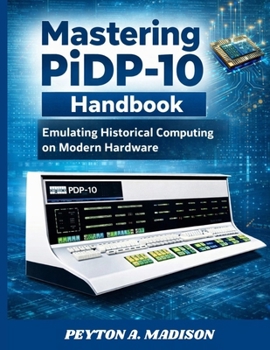
Mastering PiDP-10 Handbook: Emulating Historical Computing on Modern Hardware

By Peyton A. Madison
Have you ever wondered what it felt like to sit in front of a real mainframe?
To flip switches, watch rows of blinking lights, and interact with a system that helped shape modern computing?
What if you could do that today-without needing a university lab or a room-sized machine?
What if you could master the PDP-10 from your own desk?
Mastering PiDP-10 Handbook isn't just a technical guide. It's an invitation. An exploration. A challenge.
Are you curious about how time-sharing really worked?
How early programmers wrote software before modern IDEs existed?
How operating systems like TOPS-10, TOPS-20, and ITS managed multiple users decades before cloud computing?
And more importantly-are you ready to try it yourself?
This book walks beside you as you step into the world of the PiDP-10, the remarkable recreation of DEC's legendary PDP-10. Whether you're assembling the kit, installing the emulator, or logging into your first classic operating system, you won't be left guessing.
You won't just read about history-you'll run it.
Are you new to retro computing? Perfect.
Have you never typed a command into a 1970s-style system? Even better.
Do you think assembly language sounds intimidating? Let's demystify it together.
Inside this handbook, you'll explore:
How to set up and configure your PiDP-10 environment with clarity and confidence
How classic operating systems functioned in a true multi-user world
How to write and execute programs in languages like FORTRAN, BASIC, COBOL, ALGOL, and Lisp
How to navigate terminals, manage files, and understand system-level operations
How early computing concepts still influence the systems you use today
But here's the real question:
Do you want to understand computing-or truly experience it?
Modern systems hide complexity behind polished interfaces. The PiDP-10 reveals it. It lets you see how instructions move, how memory behaves, how processes are scheduled. It shows you the foundations.
Every expert was once a beginner staring at a blinking cursor.
Are you ready to take that step?
This handbook is written in a conversational, practical style that anticipates your questions:
"What does this command actually do?"
"Why did programmers structure systems this way?"
"What happens inside the machine when I press Enter?"
And then it answers them-clearly, patiently, and thoroughly.
You don't need prior experience.
You don't need advanced technical knowledge.
You just need curiosity.
Because here's the truth: retro computing isn't about nostalgia. It's about understanding the roots of innovation. It's about discovering how limitations inspired brilliance. It's about seeing the elegance of systems built with intention and precision.
And once you see it, you'll never look at modern computing the same way again.
So ask yourself:
Are you content using computers...
-or do you want to master one?
Are you satisfied reading about computing history...
-or do you want to step into it?
If you're ready to move from curiosity to capability, from interest to understanding, then your journey starts here.
Open the handbook.
Power up the system.
Take control.
Start mastering the PiDP-10 today.
Customer Reviews
ThriftBooks ® and the ThriftBooks ® logo are registered trademarks of Thrift Books Global, LLC
