


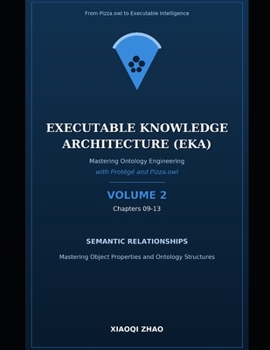
Mastering Ontology Engineering with Protégé and Pizza.owl - Volume 2: Chapters 09-13 -- Object Properties, Characteristics, Domain and Range

Mastering Ontology Engineering with Protege and Pizza.owl -- Volume 2: Object Properties, Characteristics, Domain and Range
This is Volume 2 of a multi-volume guide that teaches ontology engineering through the Pizza.owl tutorial and extends it into a modern framework for executable, enterprise-ready semantic systems.
Volume 2 is where your ontology becomes a graph. Building directly on the class hierarchy from Volume 1, you will connect classes with object properties, understand why inverse properties matter for bidirectional reasoning, and learn how property characteristics (functional, transitive, symmetric, and more) change what a reasoner can infer. The volume closes with property domain and range, the mechanism that governs which relationships are even logically permitted in your model.
What you will learn in this volume:
How to create and use object properties to connect ontology classesWhy and how to define inverse properties correctlyWhat functional, inverse-functional, transitive, and symmetric properties actually do to reasoning outputHow domain and range restrictions catch modeling errors before they become inconsistenciesHow each of these concepts connects back to the Executable Knowledge Architecture (EKA) framework introduced in Volume 1Chapters in this volume: 09 through 13.
Who this book is for: readers who have completed Volume 1 (or already know basic OWL class modeling) and are ready to build real relationships into their ontology. Also useful as a standalone reference for practitioners who need a clear, practical treatment of OWL object property semantics.
This edition includes forewords by Timothy W. Cook (Founder, Semantic Data Charter) and Michael DeBellis, along with their ongoing technical review credited throughout the book.
Volume 1 covers the foundations if you are starting fresh. Volumes 3 and 4 continue into semantic requirements and EKA governance (Volume 3) and the full Semantic Knowledge Development Lifecycle (Volume 4, in progress), and then more.
Customer Reviews
ThriftBooks ® and the ThriftBooks ® logo are registered trademarks of Thrift Books Global, LLC
