


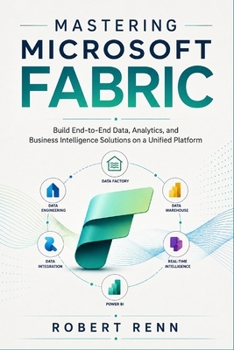
MASTERING MICROSOFT FABRIC: Build End-to-End Data, Analytics, and Business Intelligence Solutions on a Unified Platform .

What if your entire data environment could be understood as one connected system instead of a collection of separate tools?
Microsoft Fabric brings data engineering, data warehousing, business intelligence, real-time analytics, data science, and AI into a unified platform built around OneLake. But the value of the platform lies beyond its individual features. The important questions are architectural: where data belongs, how it moves, how it is modelled, how workloads interact, and how the environment is governed.
Mastering Microsoft Fabric explores those questions through a practical, technically focused journey across the platform.
From OneLake and Delta Lake to lakehouses, warehouses, Power BI, real-time intelligence, and AI, the book examines the technologies that form the Fabric ecosystem and the choices surrounding them. Topics include data ingestion, shortcuts, mirroring, PySpark, medallion architecture, T-SQL, dimensional modelling, Direct Lake, DAX, semantic models, KQL, Eventstreams, Activator, Data Agents, security, Git integration, deployment pipelines, monitoring, and capacity economics.
A continuous Northwind Provisions case study gives the technical discussion a realistic setting, following data from operational systems through ingestion, storage, transformation, analytics, streaming, and reporting.
The result is a cohesive look at Microsoft Fabric as a modern data platform, with attention to architecture, implementation, performance, governance, and the trade-offs that shape real-world environments.
For data engineers, analytics engineers, Power BI professionals, architects, and experienced data practitioners exploring Microsoft Fabric, this book provides a focused journey through the platform and the ideas that hold it together.
Customer Reviews
ThriftBooks ® and the ThriftBooks ® logo are registered trademarks of Thrift Books Global, LLC
