


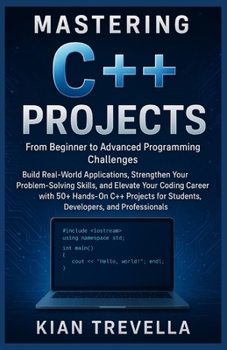
Mastering C++ Projects: From Beginner to Advanced Programming Challenges: Build Real-World Applications, Strengthen Your Problem-Solving Skills, and E
No Customer Reviews

In an era dominated by headlines about Python's simplicity, JavaScript's ubiquity, and Rust's memory safety promises, C++ stands unapologetically tall-like a seasoned grandmaster who refuses to retire. The language, born in 1979 as "C with Classes" in the labs of Bjarne Stroustrup at Bell Laboratories, has evolved through seventeen ISO standards (C++98 through C++23) into a multi-paradigm juggernaut that powers the invisible infrastructure of modern civilization.
Consider this: every time you stream 4K video on Netflix, the backend transcoding clusters are likely orchestrated by C++ microservices. When Tesla's Full Self-Driving neural networks infer at 2,000 frames per second, the inference engines are hand-optimized in SIMD-accelerated C++. The New York Stock Exchange processes three million messages per second through a C++ matching engine that achieves sub-microsecond latency. Chrome's V8 engine, Autodesk Maya, Adobe Photoshop, Bloomberg Terminal, and the entire Unreal Engine ecosystem-all are testaments to C++'s enduring dominance in performance-critical domains.
Yet C++ is not merely a tool for Fortune-500 behemoths. Indie game developers ship million-dollar Steam hits using nothing but CMake and a laptop. Embedded engineers program microcontrollers with 512 KB of RAM using C++ templates. Quantitative traders prototype algorithmic strategies in Jupyter-like environments via Cling, the interactive C++ interpreter. The language's zero-cost abstractions, deterministic resource management, and unparalleled expressiveness make it the Swiss Army knife of systems programming.
Consider this: every time you stream 4K video on Netflix, the backend transcoding clusters are likely orchestrated by C++ microservices. When Tesla's Full Self-Driving neural networks infer at 2,000 frames per second, the inference engines are hand-optimized in SIMD-accelerated C++. The New York Stock Exchange processes three million messages per second through a C++ matching engine that achieves sub-microsecond latency. Chrome's V8 engine, Autodesk Maya, Adobe Photoshop, Bloomberg Terminal, and the entire Unreal Engine ecosystem-all are testaments to C++'s enduring dominance in performance-critical domains.
Yet C++ is not merely a tool for Fortune-500 behemoths. Indie game developers ship million-dollar Steam hits using nothing but CMake and a laptop. Embedded engineers program microcontrollers with 512 KB of RAM using C++ templates. Quantitative traders prototype algorithmic strategies in Jupyter-like environments via Cling, the interactive C++ interpreter. The language's zero-cost abstractions, deterministic resource management, and unparalleled expressiveness make it the Swiss Army knife of systems programming.
Format:Paperback
Language:English
ISBN:B0FY6ZTP8F
ISBN13:9798272110015
Release Date:October 2025
Publisher:Independently Published
Length:262 Pages
Weight:0.68 lbs.
Dimensions:0.6" x 5.5" x 8.5"
Customer Reviews
0 rating
Copyright © 2026 Thriftbooks.com Terms of Use
| Privacy Policy | Do Not
Sell/Share My Personal Information | Cookie Policy | Cookie Preferences | Accessibility Statement
ThriftBooks® and the ThriftBooks® logo are registered trademarks of Thrift Books Global, LLC
ThriftBooks® and the ThriftBooks® logo are registered trademarks of Thrift Books Global, LLC
