


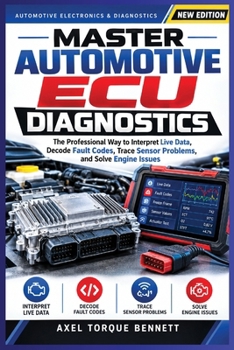
Master Automotive ECU Diagnostics: The Professional Way Interpret Live Data, Decode Fault Codes, Trace Sensor Problems, and Solve Engine Issues

STOP GUESSING. START DIAGNOSING.
A warning light comes on. A fault code appears. The engine runs rough. A sensor reading looks strange.
Now what?
Do you replace a part and hope for the best-or test the vehicle, follow the evidence, and prove what actually failed?
MASTER AUTOMOTIVE ECU DIAGNOSTICS is a practical guide to diagnosing modern vehicle electronics using a logical, evidence-based approach.
The core method is simple:
SCAN → INTERPRET → TEST → TRACE → CONFIRM → REPAIR → VERIFY
Instead of treating fault codes as automatic parts lists, you will learn how to connect DTCs, live data, electrical measurements, sensor signals, symptoms, and test results to find the real cause.
INSIDE, YOU WILL LEARN HOW TO:Understand how ECUs, sensors, actuators, and engine-management systems work together.
Build a diagnostic process from customer complaint to confirmed repair.
Use an OBD-II scanner to read DTCs, freeze-frame data, pending/permanent codes, and live data.
Understand P, B, C, and U codes and what they actually tell you.
Separate a fault code from its true root cause.
Use a multimeter for voltage, resistance, continuity, and voltage-drop testing.
Use test lights, back-probing, and safe circuit-testing techniques.
Understand what an oscilloscope can reveal beyond a scanner or multimeter.
Read wiring diagrams and trace circuits instead of guessing.
Interpret live data such as RPM, ECT, IAT, MAF, MAP, TPS, oxygen sensors, fuel trims, and throttle data.
Test MAF, MAP, TPS, ECT, IAT, CKP, CMP, oxygen, air/fuel, and knock sensors.
Distinguish sensor failures from wiring, connector, power, ground, reference-voltage, and ECU problems.
Diagnose lean/rich conditions, vacuum leaks, fuel-delivery problems, and injector faults.
Diagnose single- and multiple-cylinder misfires.
Work through hard-start and crank-no-start conditions systematically.
Investigate rough idle, stalling, hesitation, and loss of power.
Find opens, shorts, voltage drops, ground faults, and power-supply problems.
Understand CAN bus and ECU/module communication faults.
Approach difficult intermittent electrical and sensor faults.
Troubleshoot cases where the scanner cannot communicate with the ECU.
Work through practical diagnostic cases involving misfires, lean conditions, no-starts, strange live data, sensor faults, and communication failures.
Perform post-repair verification, rescanning, live-data checks, and road testing.
THINK LIKE A DIAGNOSTIC TECHNICIANThe real skill is not memorizing hundreds of codes. It is knowing how to turn information into evidence.
A sensor DTC does not automatically mean the sensor is bad. A lean condition does not automatically mean the oxygen sensor has failed. A misfire code does not automatically mean you need a new coil. A communication fault does not automatically mean the ECU needs replacement.
You will learn to ask:
What does the evidence tell me? What does it not tell me? What test can prove or eliminate the suspected cause?
The emphasis is on controlled testing, logical decisions, and verified repairs-not random parts replacement.
Learn to read the data, follow the circuit, test the condition, prove the cause, and verify the repair.
Don't chase parts. Chase evidence.
Get your copy of MASTER AUTOMOTIVE ECU DIAGNOSTICS and build a more confident, systematic approach to diagnosing modern vehicles.
Customer Reviews
ThriftBooks ® and the ThriftBooks ® logo are registered trademarks of Thrift Books Global, LLC
