


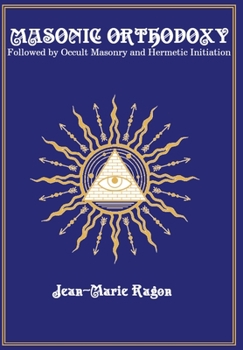
Masonic Orthodoxy: Followed by Occult Masonry and Hermetic Initiation

First published in 1853 and never before rendered into English, Jean-Marie Ragon's Masonic Orthodoxy is one of the classic works of nineteenth-century Masonic scholarship - a sweeping, opinionated, and richly documented history from a Freemason who devoted his life to the Craft. Ragon (1781-1862), a member of the Rite of Misraim and longtime Venerable Master of the lodge Les Trinosophes, which he founded, became one of the most cited historians of French Freemasonry, and this work, presented here as the introductory volume to his projected seven-part Fastes Initiatiques, remains essential reading for anyone tracing the development of the Craft from its earliest claimed origins to the proliferation of rites and high grades in the eighteenth and nineteenth centuries.
The book unfolds in three parts. Masonic Orthodoxy, the principal and longest section, follows Freemasonry from the destruction of the Druidic colleges and the symbolic ritual-work of Elias Ashmole through the 1717 founding of the Grand Lodge of London, the Craft's spread into France, Scotland, and beyond, and the turbulent chronicle of the Grand Lodge of France and Grand Orient of France - their schisms, rival councils, and the bewildering multiplication of Scottish, Templar, and other high-grade systems. Ragon closes this section with a case for restoring the three symbolic degrees to their original unity and simplicity, along with material on the Order of the Unknown Philosophers. Occult Masonry, or Treatise on the Occult Sciences turns to the esoteric currents running beneath the symbolic Craft: the numerology of Pythagoras, the occult philosophy of Agrippa, Cardan, and Paracelsus, animal magnetism and somnambulism, thaumaturgy, divination, physiognomy, and the Kabbalah. Philosophical Masonry, or Hermetic Initiation closes the volume with Hermetic and alchemical philosophy, Egyptian mythology and symbolic animals, and the principles of the Hermetic art.
S r Phosphoros, Sovereign Grand Commander of the Christian Knights of Saint-Martin, provides a translator's introduction that situates Ragon fairly - acknowledging his invaluable erudition and pioneering scholarship alongside his very real biases, including his anti-Catholic and anti-Jesuit polemics and his sometimes uneven historical rigor - so that English-speaking readers, whether initiates of Masonic and Martinist orders or scholars of the Western esoteric tradition, can evaluate this foundational work for themselves at last.
Related Subjects
History Religion Religion & Spirituality Social Science Social Sciences SpiritualityCustomer Reviews
ThriftBooks ® and the ThriftBooks ® logo are registered trademarks of Thrift Books Global, LLC
