


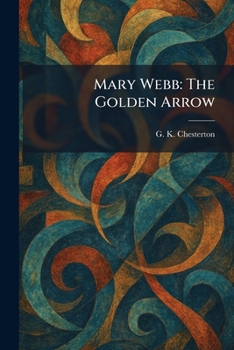
Mary Webb: The Golden Arrow

Select Format
Select Condition 
Book Overview
"The Golden Arrow" is a powerful exploration of love, faith, and the rugged beauty of the Shropshire landscape. Set against the backdrop of the Welsh Marches, the novel follows the contrasting lives and romances of Deborah Arden and Lily Huntbach. Deborah, a woman of deep spiritual conviction and connection to the earth, finds herself entangled in a relationship that tests her resilience and devotion. In contrast, Lily represents a more superficial approach to life and love, leading to a poignant study of human nature and desire.
Known for its lyrical prose and mystical atmosphere, this work captures the elemental forces of the countryside and the internal struggles of its inhabitants. Through the lens of the "Golden Arrow"-a local legend symbolizing unattainable perfection or elusive happiness-the narrative delves into themes of sacrifice, the harshness of rural existence, and the enduring power of the soul. With an introduction by the esteemed writer G.K. Chesterton, this edition highlights the literary significance of Mary Webb's unique voice, which blends regional realism with a profound sensibility. "The Golden Arrow" remains a cornerstone of early twentieth-century British literature, celebrated for its emotional depth and vivid portrayal of the natural world.
This work has been selected by scholars as being culturally important, and is part of the knowledge base of civilization as we know it. This work was reproduced from the original artifact, and remains as true to the original work as possible. Therefore, you may see the original copyright references, library stamps (as most of these works have been housed in our most important libraries around the world), and other notations in the work.
This work is in the public domain in the United States of America, and possibly other nations. Within the United States, you may freely copy and distribute this work, as no entity (individual or corporate) has a copyright on the body of the work.
As a reproduction of a historical artifact, this work may contain missing or blurred pages, poor pictures, errant marks, etc. Scholars believe, and we concur, that this work is important enough to be preserved, reproduced, and made generally available to the public. We appreciate your support of the preservation process, and thank you for being an important part of keeping this knowledge alive and relevant.
Customer Reviews
ThriftBooks ® and the ThriftBooks ® logo are registered trademarks of Thrift Books Global, LLC
