


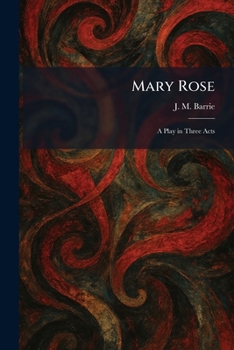
Mary Rose: A Play in Three Acts

Select Format
Select Condition 
Book Overview
"Mary Rose" is a haunting and ethereal drama in three acts that explores the boundaries between the real world and the supernatural. Written by J. M. Barrie, the play tells the story of a young woman who, while visiting a remote Scottish island known as "The Island that Likes to be Visited," mysteriously vanishes for weeks, only to reappear with no memory of her absence. Years later, after she has married and become a mother, Mary Rose returns to the same island and disappears once more-this time for decades. When she eventually returns, she has not aged a day, leading to a poignant and chilling confrontation with a world that has moved on without her.
This masterwork of twentieth-century drama blends elements of folklore, ghost stories, and psychological exploration. It delves into themes of loss, the relentless passage of time, and the enduring nature of maternal love. With its blend of whimsy and melancholy, "Mary Rose" remains one of Barrie's most complex and evocative works, capturing the elusive nature of memory and the unsettling beauty of the unknown. It is a profound meditation on the grief of those left behind and the tragic innocence of those caught between worlds.
This work has been selected by scholars as being culturally important, and is part of the knowledge base of civilization as we know it. This work was reproduced from the original artifact, and remains as true to the original work as possible. Therefore, you may see the original copyright references, library stamps (as most of these works have been housed in our most important libraries around the world), and other notations in the work.
This work is in the public domain in the United States of America, and possibly other nations. Within the United States, you may freely copy and distribute this work, as no entity (individual or corporate) has a copyright on the body of the work.
As a reproduction of a historical artifact, this work may contain missing or blurred pages, poor pictures, errant marks, etc. Scholars believe, and we concur, that this work is important enough to be preserved, reproduced, and made generally available to the public. We appreciate your support of the preservation process, and thank you for being an important part of keeping this knowledge alive and relevant.
Related Subjects
DramaCustomer Reviews
ThriftBooks ® and the ThriftBooks ® logo are registered trademarks of Thrift Books Global, LLC
