


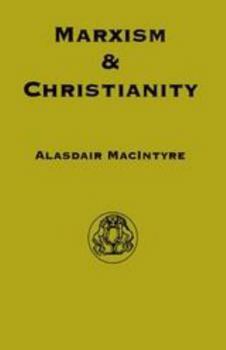
Marxism and Christianity

Select Format
Select Condition 
Book Overview
This book explores the common ground between Marxism and Christianity. It argues that Marxism shares in good measure both the content and functions of Christianity and does so because it inherits it from Christianity. It details the religious attitudes and modes of belief that appear in Marxism as it developed historically from the philosophies of Hegel and Feuerbach, and as it has been carried on by its latter-day interpreters from Rosa Luxemberg and Trotsky to Kautsky and Lukacs. It sets out to show that Marxism, no less than Christianity, is subject to the historical relativity that affects all ideologies.
This edition has been updated to take account of the collapse of Communism in the former Eastern bloc and whether Marxism, in particular, is still relevant to those who seek a changed social order today.Format:Paperback
Language:English
ISBN:0715626736
ISBN13:9780715626733
Release Date:April 1995
Publisher:Bloomsbury Academic
Length:160 Pages
Weight:0.50 lbs.
Dimensions:0.4" x 5.1" x 7.9"
Customer Reviews
1 rating
Marxism from a master Hegelian
Published by Thriftbooks.com User , 25 years ago
Mac Intyre is always worth reading. This is a slim volume, and despite the title, contains little concerning Christianity. Mainly the book serves as an overview of modern Marxism from a sympathetic vantage point. Importantly, the author finds certain key areas of overlap between Marxism and Christianity. At a philosophical level, he believes Marx takes over Hegel's reworking of core Christian themes and turns them into a secularized version of history and the millenium. Moreover, Mac Intyre sees in Marxian practice a paradox: a tendency to perpetuate proto-religious phenomena in what at times seem like cultish practices, such as Stalin's cult of the personality. More substantially, he sees a pervasive ambiguity in Marx's writings between determinism and voluntarism. In short, just how much difference does the "human factor" make in the shaping of history, a question that, in Mac Intyre's view, Marx was never able to resolve.He believes Christianity and Marxism share a key objection to modern liberalism, the dominant ideology of our age. Liberalism systematically separates fact from value: facts are one kind of thing, values are another, and there is no logical connection between them. Therefore, the individual is sovereign in deciding what to do and not do, because the world does not imply any one set of values to live by. For both Christians and Marxists, knowledge of the world and its order leads to self-knowledge and the ability to avoid predictable frustrations. Knowledge thus becomes a prerquisite to formative action that is valid not just for one person (liberalism), but for all people. At its best Marxism, like Christianity, functions as a relentless critic of society's reigning illusions - a conclusion not uncongenial to Hegel's philosophy of spiritual progression.Thus the author remains a leading Christian Hegelian in this work as well as in others.
Copyright © 2026 Thriftbooks.com Terms of Use
| Privacy Policy | Do Not
Sell/Share My Personal Information | Cookie Policy | Cookie Preferences | Accessibility Statement
ThriftBooks® and the ThriftBooks® logo are registered trademarks of Thrift Books Global, LLC
ThriftBooks® and the ThriftBooks® logo are registered trademarks of Thrift Books Global, LLC
