


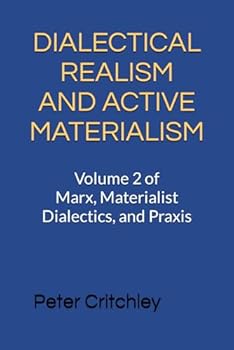
MARX, MATERIALIST DIALECTICS, AND PRAXIS: Volume 2: Dialectical Realism and Active Materialism
No Customer Reviews

Marx and Materialist Dialectics is a four volume study of Marx's critical-emancipatory praxis, locating Marx on the post-modern terrain, developing notions of an 'active materialism' in the society-nature interchange as a critique of modernity's 'alien' rationalisation. The work draws a distinction between a scientistic-deterministic Marxism and a critical-emancipatory Marxism in order to establish freedom as the end of Marx's practical critique. The book emphasises Marx's concern to facilitate the recovery of human subjectivity from behind the alienated forms in which sociability has come to be encased, thus affirming conscious, creative human agency in a self-made social world bounded by a given and inherited natural world. The book therefore places the society-nature interchange at the centre of Marx's materialist dialectics. Volume 2, Dialectical Realism and Active Materialism , divides into three parts. Part 1 Materialist Ontology This part is foundational in the way it defines the materialist dialectic and ontology of Marx and Engels. The argument checks the tendency to divide Marxism into two wings, pitching the philosophical-humanist Marx against the scientistic-naturalist Engels. The divide that opened up between a Western Marxism accenting freedom, culture, and creative agency on the one hand and the reductive, mechanical, and the economist conceptions associated with the Second and Third Internationals on the other is examined as a reproduction of the dualisms which express the inner contradictions of bourgeois thought and society - rationalism and moralism, naturalism and culturalism, scientism and emotivism. Overcoming this dualism, a Marx's materialist dialectics and ontology is shown to reconcile the two great wings of the philosophical tradition - objectivity and subjectivity. A crucial part of the argument involves a positive evaluation of Engels' attempt to extend the dialectic to nature, showing how this extension is perfectly in keeping with the integral conception of Marx's social-natural ontology. The loss of the natural dialectic is shown to skew the character of the social dialectic, losing the anchoring of praxis in reality and inviting a reversion to idealism on the one side and relapse into mechanical materialism on the other. It follows that the recovery of this natural dialectic is crucial to properly establishing Marx's social dialectic. Part 2 Revolutionary-Critical Praxis This part argues for Marx's critical and transformatory 'philosophy of praxis' as against the contemplative-passive approach to knowledge, which tends to rationalize and preserve prevailing power relations. This part shows Marx's praxis to subvert alienation, fetishism and determinism in furthering the democratisation of politics, philosophy, and power. Part 3 The Dialectic of Agency and Structure A liberatory dialectic of structure and struggle lies at the heart of the third part, showing values and society-constituting praxis to be central to Marx's emancipatory project. Emphasising the way in which Marx incorporated the active side of idealism into his materialist conception, this part employs Marx's active and affirmative materialism against naturalism and positivism. The argument develops the materialist ontology set out in the first two parts in a social context. Capitalist crisis is thus examined as a crisis transformative potential, revealing socialism as an immanent potentiality, a vision of the immanent society, the realisation of which is shown to require a self-development and self-education leading to the emergence of proletarian autonomy and subjectivity.
Format:Paperback
Language:English
ISBN:B0CQTLDJT9
ISBN13:9798872608127
Release Date:December 1997
Publisher:Independently published
Length:468 Pages
Weight:1.73 lbs.
Dimensions:9.0" x 1.1" x 6.0"
Customer Reviews
0 rating
Copyright © 2026 Thriftbooks.com
Terms of Use | Privacy Policy | Do Not Sell/Share My Personal Information | Cookie Policy | Cookie Preferences | Accessibility Statement
ThriftBooks ® and the ThriftBooks ® logo are registered trademarks of Thrift Books Global, LLC
ThriftBooks ® and the ThriftBooks ® logo are registered trademarks of Thrift Books Global, LLC
