


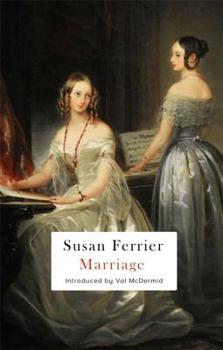
Marriage


Select Format
Select Condition 
Book Overview
Susan Ferrier sold more copies of her novels than her contemporary, Jane Austen. Sir Walter Scott declared her his equal. Why, then has she been lost to history? On the 200th anniversary of this sharply observed, comic novel, it is time to rediscover her brilliance.
'Edinburgh is reclaiming Susan Ferrier as the equal of Scottish greats in literature' SIR WALTER SCOTT AND ARTHUR CONAN DOYLE 'A forgotten literary heroine' VANESSA THORPE, GUARDIAN 'Ferrier writes with crisp, telling details and a knack for naming characters' PUBLISHERS WEEKLY 'What have you to do with a heart? What has anybody to do with a heart when their establishment in life is at stake? Keep your heart for your romances, child, and don't bring such nonsense into real life - heart, indeed ' Understanding that the purpose of marriage is to further her family, Lady Juliana nevertheless rejects the ageing and unattractive - though appropriately wealthy - suitor of her father's choice. She elopes, instead, with a handsome, penniless soldier and goes to Scotland to live at Glenfarn Castle, his paternal home. But Lady Juliana finds life in the Scottish highlands dreary and bleak, hastily repenting of following her heart. After giving birth to twin daughters, Lady Juliana leaves Mary to the care of her sister-in-law, while she returns to England with Adelaide. Sixteen years later, Mary is thoughtful, wise and kind in comparison to her foolish mother and vain sister. Following two generations of women, Marriage, first published in 1818, is a shrewdly observant and humorous novel by one of Scotland's greatest writers.Format:Paperback
Language:English
ISBN:0349011214
ISBN13:9780349011219
Release Date:December 2017
Publisher:Virago Press (UK)
Length:544 Pages
Weight:0.97 lbs.
Dimensions:1.3" x 5.1" x 7.8"
Customer Reviews
3 ratings
Perhaps the best work from Austen's contemporaries
Published by Thriftbooks.com User , 21 years ago
I've seen Susan Ferrier somewhere called the "Scottish Jane Austen", which invites comparisons that would be very hard on any author. There certainly are parallels in plot and themes between "Marriage" and "Mansfield Park". (It helps if you can imagine the latter having a very long opening about the Prices' elopement and Fanny's early life in Portsmouth.) However, Ferrier's work, although published the year after Austen's death, seems quite old-fashioned in many ways. Poetic interludes, untranslated comments in French, religious moralizing, and emblematic character names (Lady Placid, Mr. Gawffaw, Mrs. Downe Wright) combine to make the novel seem more like something Jane Austen might have read in her youth than the work of a successor. Nevertheless, the story and the elements of social satire are very well done. I found "Marriage" more interesting and more entertaining than anything I've read by Burney or Edgeworth, which I intend as praise of Ferrier, not denigration of those two talented authors.
Wonderful example of writing from that era
Published by Thriftbooks.com User , 21 years ago
I would think that anyone who loves Pride and Prejudice, etc, would also love this work written near the same time. While this author may not have the fame (or actually as good a talent) as Jane A., she still does a great job. This is a romance, of sorts. A very shallow young society woman (London) marries a Scot who, while wellbred, is a bumpkin by London standards. Twins are born, the couple separates. One twin is reared in London, the other in Scotland. One twin is shallow, the other has good sense. This is great good fun and a wonderful read. It is a shame that it is often only discovered in "History of English Literature" courses (where I got my first taste). I recommend this book highly.
Marriage
Published by Thriftbooks.com User , 26 years ago
One of the charming things about this novel is the author's handling of the old scottish dialect. It is written so that anyone can just about hear the heavily accented dialect of Scotland of the time. The text is well accompanied by explanatory notes which made it easy to understand. The novel constantly attacks the ethnic prejudices held by the English against the Scots, even as it satirizes the Scots as well. The setting is divided between Scotland and England, and the author deals satire to both cultures. The focus of the novel is its young heroine Mary. Like most young heroines in novels of this age her goal is to get married. To put it simply, the novel seems to be comparing and contrasting Mary's marriage and her methods, to those of her less scrupulous mother, an English Lady who elopes with a Scottish army officer. Mary is raised in Scotland while her twin sister goes to live in England with her mother, who cannot stand to live in Scotland. Mary goes to live with her mother when she grows to marriageable age. Here, Ferrier begins to compare and contrast the two characters, Mary and her sister, to expose which one has the better upbringing. Mary's sister makes a bad marriage to an old and willful, but rich aristocrat who makes her desperately unhappy. Mary chooses her husband better. She picks a Scottish army officer, just like her mother did so many years ago. This officer is of course a better pick for Mary than Mary's own father was for her mother. I think that when it comes to comparing the countries of Scotland and England, Scotland wins out in this book, as the best and kindest characters are Scottish, while every English character is vain or vulgar, or vain and vulgar at the same time. For this reason the novel seems full of Scottish nationalistic spirit. This is a novel of manners in the tradition of Jane Austen and Frances Burney, and the first such novel I have read which compares the two cultures in question with any seriousness and depth. Not a very flattering novel if you have ever eloped.
Copyright © 2026 Thriftbooks.com
Terms of Use | Privacy Policy | Do Not Sell/Share My Personal Information | Cookie Policy | Cookie Preferences | Accessibility Statement
ThriftBooks ® and the ThriftBooks ® logo are registered trademarks of Thrift Books Global, LLC
ThriftBooks ® and the ThriftBooks ® logo are registered trademarks of Thrift Books Global, LLC
