


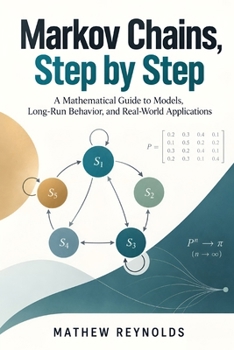
Markov Chains, Step by Step: A Mathematical Guide to Models, Long-Run Behavior, and Real-World Applications

Understand Markov chains beyond memorizing transition matrices.
Markov chains are often introduced with a simple idea: the future depends only on the present. But using that idea correctly requires more than plugging numbers into a matrix. You need to define the state properly, understand what the probabilities mean, and know when the standard formulas actually apply.
This book provides a clear, mathematical introduction to finite-state Markov chains with an emphasis on both calculation and interpretation. Instead of treating formulas as black boxes, it develops the reasoning behind them step by step and connects each major result to worked examples, exercises, and reproducible computations. The book assumes only basic algebra at the beginning. The probability and matrix tools needed for later chapters are introduced along the way, and calculus is used only in the introduction to continuous-time chains. No previous programming experience is required. Each chapter includes exercises with worked solutions, allowing you to move from reading the mathematics to actually using it.
Whether you are a student encountering stochastic processes for the first time, a self-learner strengthening your mathematical foundations, or a practitioner who wants to understand what lies behind Markov-chain calculations, this book is designed to help you move from applying formulas to understanding the models they represent.
Inside, you will learn how to:
- Define states and test whether the Markov assumption is reasonable
- Build and interpret transition matrices
- Compute multi-step transition probabilities
- Analyze transient and long-run behavior
- Find and interpret stationary distributions
- Study absorbing Markov chains and eventual outcomes
- Calculate expected times, costs, and other quantities of interest
- Work with recurring practical models such as repairable machines, service systems, and workflows
- Apply Markov chains to random walks, inventory systems, network ranking, and noisy observations
- Recognize the assumptions behind commonly used formulas
- Verify results using optional Python examples
- Develop a foundation for continuous-time Markov chains, hidden Markov models, and Markov chain Monte Carlo
Learn to calculate the answer, explain what it means, and know when you can trust it.
Customer Reviews
ThriftBooks ® and the ThriftBooks ® logo are registered trademarks of Thrift Books Global, LLC
