


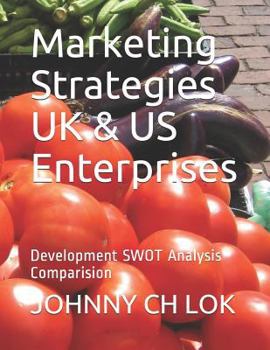
Marketing Strategies UK & Us Enterprises: Development Swot Analysis Comparision
No Customer Reviews

In UK supermarket sector is intensely competitive, and has seen continuous innovation in the way it seeks to satisfy customers' needs. As consumers have become wealthier, the supermarkets realized that buyers would no longer be content with the staple foods such as cabbage and potatoes in the depths of winter-significant numbers of them now wanted excitement on a plate, and all year round. Furthermore, if they were planning a menu, they wanted to be sure that when they went to their local supermarket.By and large, supermarkets have been key drivers of the value for the groceries that they sell. They have been close to their customers and identified their changing needs. They have built confidence with their customers, who can trust freshness and provenance of food they sell and the reliability of supply. It is therefore the supermarkets who have gone seeking sources of supply, rather than growers aggressively seeking to sell the produce that they have available. Before, the development of very large supermarket chains, retailers were morefragmented. They did not have the power or resources to innovate with new product lines which they could then commission a grower to produce. Today, supermarket such as Tesco invest heavily in their food technology laboratories, and can then go to suppliers and place large orders with exacting standards with regard to price, quality, and delivery. Above all else, supermarkets have put themselves at the center of a slick distribution system which connects an international networks of growers through transport networks of trucks, ships and planes to put fresh produce in their network of stores, every day, all year around. The efficiency of the logistics, and the bargaining power of the supermarkets has often led to the price being charged at a British supermarket being lower than the price changed in supermarkets thousands of miles away where fruit and vegetables were grown. Tomatoes grown in Bulgaria and sold in Britain can be cheaper in Britain in local Bulgarian shops. The bizarre situation has occurred where the supermarkets import apples from France to be sold in Kent, the traditional home of British apple growing, plums from Poland to be sold in the grown product in Lincolnshire. Supermarkets argue that sourcing from overseas is not just an issue of cost saving more importantly, the supermarkets seek a continuity of supplies from large growers who can guarantee to deliver a specified quantity at a specified quantity at a specified time and place. The supermarkets capable of achieving this. British supermarkets are among the most efficient in the world, and their desire to ensure that customers can always get what they want may explain the mass transport of food. Local farmers' market may could environmentally friendly, but they rarely guarantee a continuity of supplies. As part of their drive for efficiency, supermarkets have a tendency to move food, such potatoes could being transported several hundred miles between distribution centers before they end up on a supermarket shelf just a few miles from where potatoes were grown. The environmental campaigning group Sustain has estimated that the average children travels 2,000 between the farm where it was grown and the supermarket shelf and furthermore the distance products travel from farm to end customer increased by an estimated 25 per cent between 1980 year and 2007 year ( Priesnitz 2007).
Format:Paperback
Language:English
ISBN:179385128X
ISBN13:9781793851284
Release Date:January 1
Publisher:Independently Published
Length:190 Pages
Weight:1.37 lbs.
Dimensions:0.5" x 8.5" x 11.0"
Customer Reviews
0 rating
Copyright © 2025 Thriftbooks.com
Terms of Use | Privacy Policy | Do Not Sell/Share My Personal Information | Cookie Policy | Cookie Preferences | Accessibility Statement
ThriftBooks ® and the ThriftBooks ® logo are registered trademarks of Thrift Books Global, LLC
ThriftBooks ® and the ThriftBooks ® logo are registered trademarks of Thrift Books Global, LLC
