


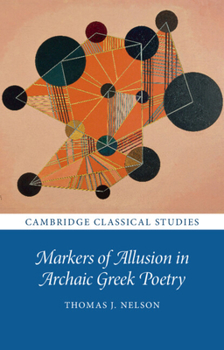
Markers of Allusion in Archaic Greek Poetry
No Customer Reviews

Select Format
Select Condition 
Book Overview
Challenging many established narratives of literary history, this book investigates how the earliest known Greek poets (seventh to fifth centuries BCE) signposted their debts to their predecessors and prior traditions - placing markers in their works for audiences to recognise (much like the 'Easter eggs' of modern cinema). Within antiquity, such signposting has often been considered the preserve of later literary cultures, closely linked with the development of libraries, literacy and writing. In this wide-ranging new study, Thomas Nelson shows that these devices were already deeply ingrained in oral archaic Greek poetry, deconstructing the artificial boundary between a supposedly 'primal' archaic literature and a supposedly 'sophisticated' book culture of Hellenistic Alexandria and Rome. In three interlocking case studies, he highlights how poets from Homer to Pindar employed the language of hearsay, memory and time to index their allusive relationships, as they variously embraced, reworked and challenged their inherited tradition.
Format:Hardcover
Language:English
ISBN:1316514374
ISBN13:9781316514375
Release Date:May 2023
Publisher:Cambridge University Press
Length:458 Pages
Weight:1.49 lbs.
Dimensions:1.0" x 5.5" x 8.5"
Related Subjects
HistoryCustomer Reviews
0 rating
Copyright © 2026 Thriftbooks.com Terms of Use
| Privacy Policy | Do Not
Sell/Share My Personal Information | Cookie Policy | Cookie Preferences | Accessibility Statement
ThriftBooks® and the ThriftBooks® logo are registered trademarks of Thrift Books Global, LLC
ThriftBooks® and the ThriftBooks® logo are registered trademarks of Thrift Books Global, LLC
