


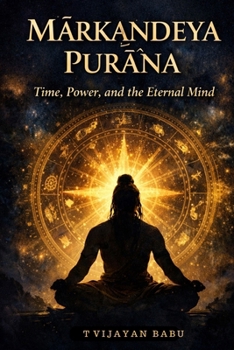
Mārkaṇḍeya Purāṇa: Time, Power and the Eternal Mind

The Mārkaṇḍeya Purāṇa is one of the most profound and contemplative texts of the Purāṇic tradition, exploring time, consciousness, power, and liberation with rare philosophical depth. This book presents the essence of that ancient wisdom in a form accessible to the modern global reader-without diluting its spiritual gravity or symbolic richness. It is not a retelling of mythology alone, but an invitation to understand how ancient seers perceived existence itself.
At the heart of this work stands Mārkaṇḍeya, the immortal seer who witnesses cosmic dissolution without fear. His story becomes a doorway into timeless awareness, revealing that what truly endures is not form, history, or identity, but consciousness itself. Through his vision, the reader is guided beyond ordinary notions of life and death into a deeper understanding of presence.
The book unfolds the Purāṇic vision of time as cyclical rather than linear. Yugas, kalpas, creation, dissolution, and renewal are explored not merely as cosmological ideas, but as rhythms reflected in human psychology and civilization. This perspective challenges modern anxieties about progress and collapse, offering instead a wider, calmer view of change.
A central portion of the book is devoted to the Devī Māhātmya, where the Goddess arises as the power that restores balance when order collapses. Here, divine battles are revealed as inner and collective struggles-between ignorance and clarity, excess and restraint, fear and wisdom. The Goddess is presented not as mythic spectacle, but as integrative intelligence that awakens when fragmentation becomes unbearable.
Moving inward, the book examines the human condition in an impermanent universe. Fear, desire, suffering, ego, and detachment are addressed with psychological sensitivity and spiritual realism. Rather than moral judgment, the text offers recognition-showing how bondage arises through misperception and how freedom begins with understanding.
The later sections explore kingship, society, and civilizational order, drawing timeless lessons on leadership, justice, responsibility, and decline. These chapters speak powerfully to contemporary concerns, revealing how societies rise and fall according to their alignment with dharma rather than wealth or force alone.
The journey then turns decisively inward, addressing the inner battlefield, courage, devotion beyond ritual, silence, and meditation. Here, spirituality is stripped of performance and reduced to essence-clarity, humility, attentiveness, and inner strength. Devotion becomes a way of being rather than a ritual act.
The culmination of the book lies in its exploration of death, immortality, and mokṣa-freedom from the wheel of suffering and repetition. Liberation is presented not as escape from life, but as freedom within it. Time dissolves into awareness, and fear loosens its grip on existence.
Written in a reflective, meditative style, this book does not demand belief or conversion. It welcomes readers from all backgrounds-spiritual seekers, philosophy readers, students of mythology, and those drawn to contemplative thought. Each chapter stands on its own while contributing to a larger, carefully structured journey.
The Mārkaṇḍeya Purāṇa: Time, Power, and the Eternal Mind is a book to be read slowly and returned to often. It offers not answers to memorize, but insights to live by-restoring stillness in an age of noise, clarity in an age of confusion, and depth in an age of haste.
Customer Reviews
ThriftBooks® and the ThriftBooks® logo are registered trademarks of Thrift Books Global, LLC
