


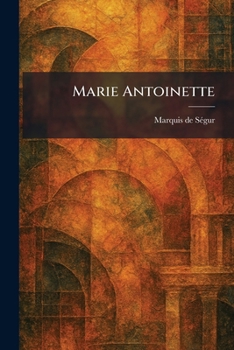
Marie Antoinette

"Marie Antoinette" offers an intimate and scholarly exploration of one of history's most misunderstood and tragic figures. Written by the Marquis de S gur, a noted historian and expert on the French court, this work provides a detailed portrait of the Archduchess of Austria who became the last Queen of France before the French Revolution.
The narrative follows Marie Antoinette from her arrival at Versailles as a young bride to the height of her influence and her eventual downfall. S gur examines her complex personality, her relationships within the royal family, and the shifting social and political tides that turned a nation against her. By utilizing historical records and contemporary accounts, the author attempts to look beyond the scandalous myths and caricatures of the era to find the human being beneath the crown.
Rich in period detail and psychological insight, "Marie Antoinette" is an essential read for those interested in the 18th-century French monarchy, the intricacies of court life, and the dramatic end of the Ancien R gime. This biography remains a significant and eloquent contribution to the study of the French Revolution and the life of its most famous female protagonist.
This work has been selected by scholars as being culturally important, and is part of the knowledge base of civilization as we know it. This work was reproduced from the original artifact, and remains as true to the original work as possible. Therefore, you may see the original copyright references, library stamps (as most of these works have been housed in our most important libraries around the world), and other notations in the work.
This work is in the public domain in the United States of America, and possibly other nations. Within the United States, you may freely copy and distribute this work, as no entity (individual or corporate) has a copyright on the body of the work.
As a reproduction of a historical artifact, this work may contain missing or blurred pages, poor pictures, errant marks, etc. Scholars believe, and we concur, that this work is important enough to be preserved, reproduced, and made generally available to the public. We appreciate your support of the preservation process, and thank you for being an important part of keeping this knowledge alive and relevant.
Customer Reviews
ThriftBooks ® and the ThriftBooks ® logo are registered trademarks of Thrift Books Global, LLC
