
Skip to content
Scan a barcode
Scan
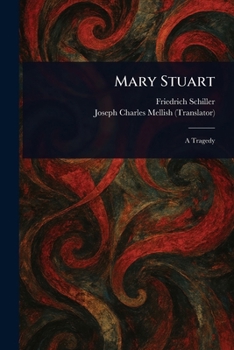
Paperback Mary Stuart Book

ISBN: 1023097575

ISBN13: 9781023097574

Mary Stuart

Select Format

Select Condition ThriftBooks Help Icon

Recommended

Format: Paperback

Condition: New

$22.95
Ships within 2-3 days
Save to List

Book Overview

Frederich Schiller's "Mary Stuart: A Tragedy" plunges into the heart of 16th-century British history, dramatizing the tumultuous relationship between Mary, Queen of Scots, and Elizabeth I. This historical drama, meticulously prepared for print republication, explores the complex dynamics of power, ambition, and fate that defined an era.

Set against the backdrop of Scottish and English political intrigue, Schiller's work offers a compelling lens through which to view a pivotal period in European history. Examining the reign of Elizabeth I, the play delves into the conflicts and tensions that shaped Great Britain during the Renaissance. Experience the enduring power of Schiller's vision in this classic exploration of queens, countries, and the relentless march of history. A timeless tale of ambition, betrayal, and the collision of two powerful women.

This work has been selected by scholars as being culturally important, and is part of the knowledge base of civilization as we know it.

This work is in the public domain in the United States of America, and possibly other nations. Within the United States, you may freely copy and distribute this work, as no entity (individual or corporate) has a copyright on the body of the work.

Scholars believe, and we concur, that this work is important enough to be preserved, reproduced, and made generally available to the public. We appreciate your support of the preservation process, and thank you for being an important part of keeping this knowledge alive and relevant.

Customer Reviews

3 ratings

What to do?

Friedrich Schiller wrote this drama about the power struggle between Elizabeth of England and Mary of Scotland after he finished the Wallenstein trilogy, his Thirty Years War drama. He finished MS in 1800 and it had a triumphant stage premiere shortly afterwards, in Weimar. Schiller was by now `over' his Sturm und Drang period and had become a co-leader of classicism, teaming up with Goethe. He said of this play that he had had enough of war and heroes and soldiers, he was looking more for passionate humanity than for history. Consequently he wrote a credible drama about semi-fictional characters. As long as you don't confuse this with historiography, the method is fine with me. The drama focuses on Mary's last 3 days, beginning with her verdict in the first of five acts. Mary does not recognize the authority of the court. She sees herself as a state guest, the legitimate queen of another country who had come to England asking for shelter. She had fled Scotland after her own murderous activities had made her unsafe there. In England she had been put in jail, now since 19 years. Her imprisonment is motivated by the fact that she would have been able to claim a possibly better right to England's throne than the current job holder. In other words, Elizabeth has reasons to fear her, especially in view of her Catholic backing in France and Spain. Apart from that personal motive, Elizabeth has the pressure from her court that fears a return to a Catholic ruler. On the other hand there may be benefits in a milder rule. Mary's state of mind in captivity is ambivalent: she resents the treatment that she is given, hopes to be able to talk to Elizabeth and reach an understanding, but at the same time she is haunted by her own conscience about her past murder of her husband at home. The trial against her is however about something else. She is accused of having tried to conspire with England's enemies to usurp the throne. Mary feels innocent in that respect and even her captors are aware that the trial itself was not following proper procedure. Schiller weaves a conspiracy of an attempted jail break involving some double-dealing noblemen. But the true high point of the play is a personal confrontation between the two lionesses. Pride, jealousy, fear, humiliation come into play. Mary wins the battle and loses the war. Elizabeth had been of a split mind, but Mary's aggressive and offensive behavior towards her leaves her no choice. Still she tries to escape direct personal responsibility for ordering an execution - in vain. The plot in Schiller's version probably has as many holes as a sieve, historically, but as a human confrontation it works very well. The language has matured since the puerile enthusiasm of some earlier plays. There is also, luckily, no morality tale, no attempt to manipulate the audience to whatever good cause. The play has been staged recently in London, to much acclaim, and traveled to the Broadway from there. Which goes to show t

A Masterpiece

A brilliant psychological drama. Schiller begins with presenting Mary as the epitome of passion and misguided sincerity, with Elizabeth as the epitome of rational calculation and statecraft. With superb plotting, he stages their confrontation to emphasize their common features and with elements of role reversal. The confrontation essentially purifies their original characters, heightening the contrast between passion and calculation. I don't read German but this translation contains a great deal of eloquent language and an appropriately Shakerspearean flavor.

The "Mary, Queen Of Scots" Play Used In "Anne Of Avonlea"

This is the play that was used in the 1987 (?) movie, "Anne of Avonlea." It's really neat!
Copyright © 2026 Thriftbooks.com Terms of Use | Privacy Policy | Do Not Sell/Share My Personal Information | Cookie Policy | Cookie Preferences | Accessibility Statement
ThriftBooks® and the ThriftBooks® logo are registered trademarks of Thrift Books Global, LLC

GoDaddy Verified and Secured