


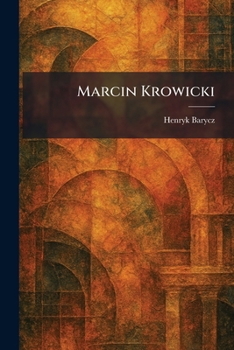
Marcin Krowicki

"Marcin Krowicki" by Henryk Barycz provides an insightful historical and biographical examination of one of the most compelling figures of the Polish Reformation. Marcin Krowicki (1501-1573) was a Catholic priest whose spiritual journey led him to become a prominent leader and polemicist within the Polish Brethren movement. This work delves into the theological shifts and social challenges Krowicki faced as he navigated the tumultuous religious landscape of 16th-century Poland.
Barycz, a noted historian, meticulously charts Krowicki's evolution from a parish priest to a radical reformer known for his defense of the common people and his sharp critiques of the ecclesiastical hierarchy. The book explores Krowicki's literary contributions, including his influential polemics and his role in shaping the identity of the Antitrinitarian movement in Eastern Europe. Through this study, readers gain a deeper understanding of the intellectual and religious ferment that defined the Golden Age of Poland. This volume is an essential resource for those interested in the history of the Reformation, the development of unitarian thought, and the socio-political history of the Polish-Lithuanian Commonwealth.
This work has been selected by scholars as being culturally important, and is part of the knowledge base of civilization as we know it. This work was reproduced from the original artifact, and remains as true to the original work as possible. Therefore, you may see the original copyright references, library stamps (as most of these works have been housed in our most important libraries around the world), and other notations in the work.
This work is in the public domain in the United States of America, and possibly other nations. Within the United States, you may freely copy and distribute this work, as no entity (individual or corporate) has a copyright on the body of the work.
As a reproduction of a historical artifact, this work may contain missing or blurred pages, poor pictures, errant marks, etc. Scholars believe, and we concur, that this work is important enough to be preserved, reproduced, and made generally available to the public. We appreciate your support of the preservation process, and thank you for being an important part of keeping this knowledge alive and relevant.
Customer Reviews
ThriftBooks ® and the ThriftBooks ® logo are registered trademarks of Thrift Books Global, LLC
