


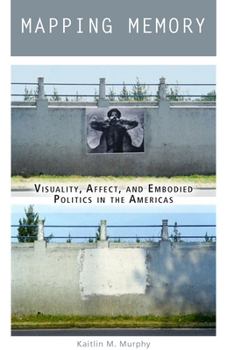
Mapping Memory: Visuality, Affect, and Embodied Politics in the Americas
No Customer Reviews

In Mapping Memory, Kaitlin M. Murphy investigates the use of memory as a means of contemporary sociopolitical intervention. Mapping Memory focuses specifically on visual case studies, including documentary film, photography, performance, new media, and physical places of memory, from sites ranging from the Southern Cone to Central America and the U.S.-Mexican borderlands. Murphy develops new frameworks for analyzing how visual culture performs as an embodied agent of memory and witnessing, arguing that visuality is inherently performative. By analyzing the performative elements, or strategies, of visual texts--such as embodiment, reenactment, haunting, and the performance of material objects and places Murphy elucidates how memory is both anchored in and extracted from specific bodies, objects, and places. Drawing together diverse theoretical strands, Murphy originates the theory of "memory mapping", which tends to the ways in which memory is strategically deployed in order to challenge official narratives that often neglect or designate as transgressive certain memories or experiences. Ultimately, Murphy argues, memory mapping is a visual strategy to ask, and to challenge, why certain lives are rendered visible and thus grievable and others not.
Format:Hardcover
Language:English
ISBN:0823282546
ISBN13:9780823282548
Release Date:October 2018
Publisher:Fordham University Press
Length:208 Pages
Weight:0.90 lbs.
Dimensions:0.8" x 6.2" x 9.1"
Customer Reviews
0 rating
Copyright © 2026 Thriftbooks.com
Terms of Use | Privacy Policy | Do Not Sell/Share My Personal Information | Cookie Policy | Cookie Preferences | Accessibility Statement
ThriftBooks ® and the ThriftBooks ® logo are registered trademarks of Thrift Books Global, LLC
ThriftBooks ® and the ThriftBooks ® logo are registered trademarks of Thrift Books Global, LLC
