


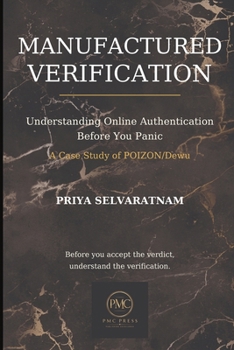
Manufactured Verification

What does an authentication result actually prove?
As third-party authentication platforms gain influence across global commerce, their verdicts increasingly affect purchasing decisions, inventory acceptance, payments, reputations, and commercial relationships. Yet a simple "pass" or "fail" can conceal the limitations of the process behind it.
In Manufactured Verification, beauty-industry executive and author Priya Selvaratnam examines the crucial distinctions between opinion, expertise, evidence, and authority. Beginning with a real commercial dispute involving skincare products, she investigates how authentication decisions are reached-and what can happen when an independent assessment is treated as unquestionable proof.
Using POIZON/Dewu as the central case study, Selvaratnam analyzes platform policies, disclaimers, documented communications, public materials, visual-assessment practices, reference databases, market-specific packaging differences, and the evidentiary limits of physical inspection. She explores why identifying a difference does not automatically explain what caused it-and why photographs, visual reviews, laboratory testing, manufacturer records, and proprietary databases do not carry equal evidentiary weight.
This book does not argue against authentication. It challenges readers to look beyond the verdict and examine the methodology, reference standards, qualifications, limitations, and authority supporting it.
Written for distributors, retailers, resellers, brand owners, buyers, importers, legal professionals, and consumers, Manufactured Verification offers a practical framework for evaluating authentication results before they trigger accusations, rejected inventory, financial loss, or reputational damage.
Before accepting a verdict, ask the question that matters most:
What evidence justified it?
Customer Reviews
ThriftBooks ® and the ThriftBooks ® logo are registered trademarks of Thrift Books Global, LLC
