


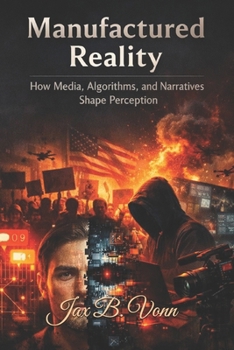
Manufactured Reality: How Media, Algorithms, and Narratives Shape Perception

Manufactured Reality: Media, Narratives, and the Engineering of Perception is a penetrating examination of how modern information ecosystems shape what societies believe to be true. This book argues that distortion is not merely the result of bad actors or isolated misinformation, but the predictable outcome of systems optimized for engagement, speed, and monetization. In a world governed by algorithms, visibility is not neutral-and what rises to prominence often does so because it triggers emotion, reinforces identity, or sustains attention.
Through a rigorous analysis of narrative framing, algorithmic amplification, monetized outrage, weaponized identity, and information asymmetry, this work exposes how perception is engineered at scale. It explores how early narrative capture can define public understanding before evidence stabilizes, how outrage becomes a profitable business model, and how digital infrastructure quietly determines what is seen, repeated, and remembered. The book reveals that influence today operates less through overt censorship and more through ranking systems, predictive modeling, and cross-platform feedback loops that shape salience invisibly.
Rather than treating media as a neutral channel, Manufactured Reality treats it as architecture-designed, optimized, and continuously recalibrated. It examines how engagement-based economics reward escalation, how personalization fragments shared reality, and how emotional intensity often outcompetes contextual accuracy. The result is not uniform deception but segmented perception, where competing clusters inhabit different narrative hierarchies.
Yet this book is not simply diagnostic. It outlines structural pathways for reclaiming the signal: recalibrating incentives, increasing transparency, strengthening institutional credibility, and redesigning amplification systems to reward proportion and verification. The goal is not to eliminate disagreement but to restore balance to the terrain on which ideas compete.
At a time when truth must fight for visibility, Manufactured Reality offers a clear-eyed exploration of the systems shaping modern belief-and a blueprint for rebuilding informational resilience in an age of engineered perception.
Customer Reviews
ThriftBooks ® and the ThriftBooks ® logo are registered trademarks of Thrift Books Global, LLC
