


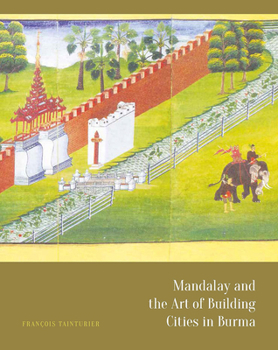
Mandalay and the Art of Building Cities in Burma
No Customer Reviews

Drawing on original Burmese texts and illustrations, recent scholarship, and mapping, Mandalay and the Art of Building Cities in Burma argues that the founding of Mandalay shifted critically in emphasis and scale during its planning from a protocol that established the royal city as a "cosmic city" to one that viewed the royal capital as a sanctuary. As part of that shift, Fran?ois Tainturier shows, the founding protocol used Buddhist narratives as models for action and drastically altered patterns of spatial order that had been prevalent at former royal capitals. The systematic planning of Mandalay and the construction of its potent landscape constituted the expression--formulated not in words but in tangible form--of the throne's claim that Burma was a "Buddhist land," at a time when Lower Burma had been annexed by non-Buddhist believers. Tainturier provides further insight into how rulers articulated their lineage, power, and the promotion of Buddhism by creating potent landscapes. Mandalay and the Art of Building Cities in Burma renews scholarly discussion on Southeast Asian urban traditions and offers a critical investigation into the "cosmic" dimensions of one of the region's centers of power.
Format:Hardcover
Language:English
ISBN:9814722774
ISBN13:9789814722773
Release Date:June 2021
Publisher:National University of Singapore Press
Length:240 Pages
Weight:2.05 lbs.
Dimensions:0.9" x 7.5" x 9.4"
Customer Reviews
0 rating
Copyright © 2026 Thriftbooks.com
Terms of Use | Privacy Policy | Do Not Sell/Share My Personal Information | Cookie Notice | Cookie Preferences | Accessibility Statement
ThriftBooks ® and the ThriftBooks ® logo are registered trademarks of Thrift Books Global, LLC
ThriftBooks ® and the ThriftBooks ® logo are registered trademarks of Thrift Books Global, LLC
