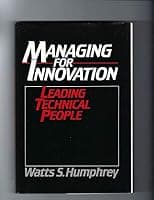
Providing practical insights on how to best manage technical professionals, this text demonstrates that people are important in building software systems and suggests how to identify, motivate and organize innovative people. The work explains how teams can be used to solve difficult problems and underlines that successful software development has two basic requirements: a well-defined, quality-based process; and the best technical people. This description may be from another edition of this product.
Solid Advice for Software Development Professionals
By Thriftbooks.com User, November 15, 2008
The examples can be kind of wordy and not always widely relevant, but there's a lot of good common sense and eye opening truth here for developers of all kinds (although probably mostly for leads, managers, execs).
0
★★★★☆
Great management book
By Thriftbooks.com User, February 22, 2002
This is a great book for someone who's looking for cases and practical ideas. It doesn't give any numerical analyses or "magical" formulas. It's a guide for project managers and how to manage different people with different skills and professional perspectives.
0
★★★★★
Great book on Management!
By Thriftbooks.com User, February 18, 2002
This book is a great book for anyone who currently manages and wants to understand how to get the most out of his team. It has plenty of great suggestions to improve people-development as well as process-development. But more important than the suggestions, this book explains why and how certain courses of action succeed while others fail.Too often technical people are promoted into management with no training. One cannot learn how to manage by merely performing technical tasks. One can learn by reading books like this one.
0
★★★★☆
Really perceptive book
By Thriftbooks.com User, January 18, 2000
Keenly written book, shows the depth of Watts Humphrey's experience. Greatly rewarding for anyone who is willing to look at situations without applying oppressor/oppressed stereotypes. The book will sail cleanly over the heads of those who do not have at least 4-5 years of hands-on management experience, and will boink the others between the eyes. The sections where he talks about why technical people appear dissatisfied and how managers fail them were just amazingly useful once I forgot to fight the contents.
0
★★★★☆
Flawed but useful
By Thriftbooks.com User, July 8, 1999
This book is rich in detailed advice about managing teams of engineers. Futhermore Watts Humphrey uses many interesting examples --- some anecdotal, some from his experience at IBM, and some historical --- to illustrate this advice. My favorite example involved President Theodore Roosevelt and the introduction of continuous-aim firing in the US Navy.However, there is a flaw that runs through this book from the beginning to the end. Humphrey assumes that the organizational context is a large vertically integrated company like IBM circa 1970. That kind of company has all but disappeared nowadays. It is rare for large companies to develop new products today --- instead they buy the startup that has already developed the product they want. Important champions aren't powerful executives; rathey they are wealthy angels or powerful venture capitalists that fund the startups. Interestingly, this flaw hurts some chapters and hardly affects others. For example, the chapter on the importance of the commitment ethic remains true even though the organizational context is very different nowadays.