


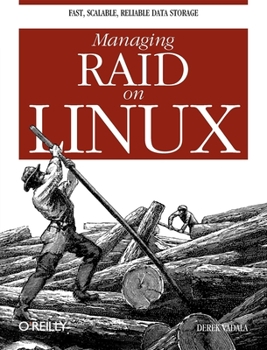
Managing Raid on Linux: Fast, Scalable, Reliable Data Storage

Select Format
Select Condition 
Book Overview
Redundant Array of Independent Disks (RAID) technology is becoming a standard feature of computer systems that support mission-critical services like file sharing, mail exchange, or Web servers. RAID offers two benefits to these essential systems: improved I/O performance and fail-safe data storage. Although bandwidth problems on networks are well documented, the internal data transfer bottleneck that exists at the hardware level in each system can also leave you with perplexing performance issues. RAID is a cost-effective and easy-to-manage way to alleviate this bandwidth problem by distributing the I/O load seamlessly across multiple disks and controllers. RAID also provides uninterrupted data access through disk mirroring and parity algorithms. That means systems can remain online even during a disk or controller failure. RAID is scalable, making it robust enough for large, high-traffic sites and small, critical systems. By using RAID, system administrators can combine single disks into terabytes worth of data storage. Managing RAID on Linux covers everything system administrators need to know to put together a system that can support RAID. You will learn about the different types of RAID, along with associated technologies and issues, and how to choose the best RAID system for your needs. With a step-by-step, hands-on approach, the author guides you through the installation of either Linux software RAID or a hardware RAID card. The book shows how to build an array and optionally install a high-performance file system. Contents include: An introduction to RAID and Linux Planning and architecture of your RAID system Building a software RAID Software RAID tools and references Building a hardware RAID Performance and tuning of your RAID system RAID has become the low-cost solution of choice to deal with the ever-increasing demand for data storage space. Written for system administrators, power users, tech managers, and anyone who wants to learn about RAID technology, Managing RAID on Linux sidesteps the often-confusing vendor-specific approach you'll find elsewhere to give you the straight story on RAID. Even non-Linux users will find this book full of valuable material.
Format:Paperback
Language:English
ISBN:1565927303
ISBN13:9781565927308
Release Date:January 2003
Publisher:O'Reilly Media
Length:260 Pages
Weight:3.85 lbs.
Dimensions:0.6" x 7.0" x 9.2"
Related Subjects
Computers Computers & Technology Home Computing & How-to Linux Operating Systems Software UnixCustomer Reviews
2 ratings
introduces RAID to the masses
Published by Thriftbooks.com User , 23 years ago
The availability of HOW-TOs and newsgroups is supposed to make the sysadmin's job easier, right? Much as I am a proponent of the 'distributed learning model' for Linux, the endless searching for answers on the Web for setting up Linux RAID was getting to be a royal pain. Sure, there was a RAID how-to and an excellent newgroup, but some of the information is out of date, and the tricks suggested by people a year ago may be no longer needed today.A person deciding to go with RAID faces a panoply of options andgotchas. Hardware or software? How many controllers? ATA or CSI (or ataraid)? RAID 1 or RAID 5? Which file system or disstribution? Kernel options? Mdadm or raidtools? /swap or /boot on raid? Hybrid? Left or right symmetric? One poster pointed out that putting two ATA drives on the same controller could impact performance. Yikes! Didn't I do that? Upon discovering that O'Reilly had just published its Managing RAID on Linux book, looking at sample chapter , I bought the book and let my blood pressure return to normal.RAID is one of these subjects that is really not complex; it's just very hard to find all the information in one place. This is precisely the book to solve the problem. Author Derek Vadala, sysadmin and founder of Azurance, an open source/security consulting firm, has gathered a lot of information and even personal anecdotes to go through the decision making process when going over to RAID. He goesstep-by-step through that process, educating us about hard drives, controllers, and bottlenecks along the way. This exhaustive book may be the first to bring RAID to the masses.Although parts of the book (RAID types, file system types) may seem already familiar to experienced Linux users, it is helpful nonetheless to have everything in a nifty little book. A section of file systems provided not only a rundown of the merits and drawbacks of each one, but also a guide to their utilities. I learned for example what "file tails" for Reiser are, and why using them causes performance to degrade after reaching 85% capacity. The book compares raidtools withmdadm as well as lovely commands to email you RAID status reports upon boot).People who use software RAID may skip over the chapter on RAIDutilities for the leading RAID controller cards. Still, there was one interesting tidbit: Why, the author asks, do makers of controller cards put all their BIOS utilities on DOS floppies which require us to find a DOS boot disk? Seriously, how many of us carry around DOS boot disks nowadays? The book made me aware for the first time of freedos, an open source solution that solves precisely that problem.The Software RAID stuff was pretty thorough and clarified a lot of things. The book does an excellent job in helping to identify and eliminate bottlenecks and optimizing hard drive performance (using hdparm and various monitoring commands). The anecdotes and case studies definitely clarified which RAID solution is suited for which task.I am less impressed by
Great reference for admins
Published by Thriftbooks.com User , 23 years ago
The book covers RAID and storage concepts on Linux systems. The book covers a lot of RAID concepts which are typically not covered collectively in sysadmin books or certification exams.This book is great especially if you're a non-Unix systems administrator responsible for some Linux machines. The reference chapters themselves are worthy of 'keep handy' status in the admin's collection.If you're interested in strict network or vendor storage technology such as SANs then this book is not for you. However, beneath the SAN and other storage network concepts lie the tried-and-true RAID techonolgies. One only has to look at current network appliance vendors to see that Linux is well suited to handle RAID on their products.
Copyright © 2026 Thriftbooks.com Terms of Use
| Privacy Policy | Do Not
Sell/Share My Personal Information | Cookie Policy | Cookie Preferences | Accessibility Statement
ThriftBooks® and the ThriftBooks® logo are registered trademarks of Thrift Books Global, LLC
ThriftBooks® and the ThriftBooks® logo are registered trademarks of Thrift Books Global, LLC
