


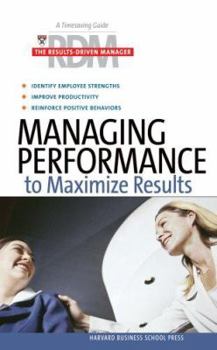
Managing Performance to Maximize Results (Results-Driven Manager)

A manager tackles a wide range of responsibilities. Evaluating employee performance is arguably one of the most crucial managerial tasks. This guide shows managers how to develop high-performing employees by making both formal and informal performance assessments and feedback part of your everyday interactions.
Format:Paperback
Language:English
ISBN:1422114678
ISBN13:9781422114674
Release Date:May 2007
Publisher:Harvard Business Press
Length:183 Pages
Weight:0.05 lbs.
Dimensions:8.5" x 0.5" x 5.0"
Customer Reviews
1 rating
Accelerated Coverage of "Basics"
Published by Thriftbooks.com User , 18 years ago
Harvard Business School Press publishes three series of paperbacks: "Harvard Business Essentials," with each subject-specific volume written by Richard Luecke in collaboration with a subject adviser; "The Harvard Business Review Paperback Series," with each subject-specific volume consisting of articles which originally appeared in Harvard Business Review; and "The Results-Driven Manager [RDM] Series," with each subject-specific volume consisting of articles from Harvard Management Update and Harvard Management Communication Letter. The RDM volume I am about to discuss focuses on an especially important business subject: how to manage performance to maximize results by identifying employee strengths, improving productivity, and reinforcing behaviors. After a remarkably informative Introduction by an unidentified author, the material is organized as follows. In the four articles which comprise the first, Maximize Your Performance Management System, the contributors explain why and how the most effective performance management appraisal systems "exhibit shared characteristics - such as ongoing-two-way exchanges of feedback; regular coaching between manager and employee; separation of conversations devoted to professional development and compensation decisions; and explicit links between performance goals and high-level company objectives." In the four articles that comprise the second section, Handling Excellent, Average, and Poor Performers, the contributors explain "why it's important to customize performance reviews for top talent, average contributors, and poor performers. But how, precisely, should the feedback be tailored for each of these employee categories?" Excellent question. They provide helpful guidance so that supervisors can "leverage star performers' abilities and bring average performance up a notch or two - as well as address inadequate on-the-job contributions." Then in the third section, Understanding the Power of Expectations, the reader is provided with a wealth of "potent techniques for leveraging the power of expectations to maximize their direct reports' performance." For example, suggestions as to how to invite employees' input on the expectations proposed, how to link expectations to each direct report's unique and deepest interests, and how to focus on desired future change rather than rehash past performance. As for the fourth section, its articles offer insights as to how to think about performance measures now, how to use measurement to boost a group's performance (e.g. a business unit, department, or, team), how to budget for high performance, and "five keys to evaluating the performance of knowledge workers." Then in the final section, Edward Prewitt responds to a frequently asked question: "Should You Use 360º Feedback for Performance Reviews?" and then Lauren Keller Johnson offers her suggestions about "retooling 360ºs for better performance." For whom will this volume have the greatest value? My own opinion
Copyright © 2025 Thriftbooks.com
Terms of Use | Privacy Policy | Do Not Sell/Share My Personal Information | Cookie Policy | Cookie Preferences | Accessibility Statement
ThriftBooks ® and the ThriftBooks ® logo are registered trademarks of Thrift Books Global, LLC
ThriftBooks ® and the ThriftBooks ® logo are registered trademarks of Thrift Books Global, LLC
