


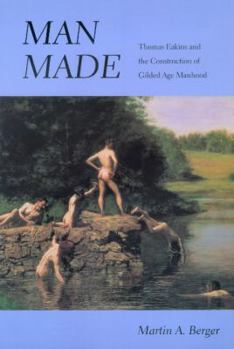
Man Made: Thomas Eakins and the Construction of Gilded Age Manhood (Men and Masculinity)


Select Format
Select Condition 
Book Overview
Often censured during his lifetime for his insistence on studying and painting from the nude, Thomas Eakins (1844-1916) is now acclaimed as one of America's greatest realist painters. Man Made... This description may be from another edition of this product.
Format:Paperback
Language:English
ISBN:0520222091
ISBN13:9780520222090
Release Date:August 2000
Publisher:University of California Press
Length:181 Pages
Weight:0.80 lbs.
Dimensions:9.0" x 0.5" x 6.0"
Customer Reviews
3 ratings
Quality Book on Eakins, Great Material/Great Value
Published by Thriftbooks.com User , 17 years ago
Admittedly biased, this book was written by a former professor of mine. But actually I didn't like him very much while I was in his class so maybe I'm not so biased after all. I used this book as a source for an American Art History essay on Eakins and thought it brought up some really interesting ideas and associations that are generally excluded from other broader texts or other glorification works on Eakins. It really focuses on his body of work first and how it relates to the period of time in which Eakins' lived rather than focus on his personal life and some of its more scandalous stories. It was also not a difficult read, which art history texts notoriously are. All in all I would give this a solid recommendation to any one interested in Eakins' art.
insightful and compelling
Published by Thriftbooks.com User , 24 years ago
This short book brilliantly explores the relationship between Eakins' work and American notions of manliness in the period. The historical grounding and the jargon-free language of the book make it especially useful for non-art historians.
A Painter's Insight into White, Middle-Class Manhood
Published by Thriftbooks.com User , 25 years ago
I have no training in art history or criticism, but I have long been fascinated by the paintings of Thomas Eakins, a minor American master of the late-19th century. This book by Martin Berger, who teaches Art History and English at the State University of New York, Buffalo, seeks to place Eakins's work within the cultural context of the "Gilded Age," an era which many social historians believe to have been characterized by a "crisis in manhood," so I approached this book with great anticipation. The text, which includes a number of illustrations, is only 123 pages long, and this is one book in which more might, indeed, have been more.In the introduction, Berger wisely informs the reader that this book is "neither a biography nor a standard art historical study." It is, instead a "cultural art history" which explores "Eakins's art in fashioning manhood for both the painter and his white, middle class contemporaries." According to Berger, Eakins's paintings "do not merely reflect cultural concerns, but are engaged in both legitimating and forming conceptions of Victorian manhood." This is intriguing because, Berger writes, "Eakins's images of men" are "characterized by physical activity, mental engagement, and nudity." Assuming that there is some broader cultural significance to these images, what do they tell us about late-19th century American society? In Berger's view: "On the simplest level, Eakins's athletic canvases offer symbolic reassurance by linking the artist to a series of unimpeachably masculine characters and professions." Berger explains that "the manliness of Eakins's athletes was a function not simply of their participation in sports, but also of their success, modernity, and `whiteness.'"According to Berger, "most critics faulted Eakins's monumental Gross Clinic of 1875...for the violence of its realism." Berger observes, however, that, after 1900, "critics began consistently to interpret the artist's bluntness as a strength." What purpose was served by Eakins's severe realism? Berger writes: "In the aftermath of the Civil War, questions of gendered identity gained ascendance as white, middle-class men struggled against sweeping national transformations." Berger explains that, in the 19th century, and especially during the great and radical economic changes after the Civil War, "middle-class men "took their social identity largely from their success or failure at work." Eakins's paintings of men at work (and play) were efforts to provide insights into their social identities. In The Champion, Single Sculls, according to Berger, Eakins seeks to convey the fact that competitive rowing's development was encouraged by the industrial revolution, and this explains why the sculler is depicted against a background containing railroad bridges, a train, and a steamboat. In The Biglin Brothers Turning the Stake Boat, according to Berger, "Eakins "points to rowing's reliance on both physical and mental skills." Berger conclud
Copyright © 2026 Thriftbooks.com
Terms of Use | Privacy Policy | Do Not Sell/Share My Personal Information | Cookie Notice | Cookie Preferences | Accessibility Statement
ThriftBooks ® and the ThriftBooks ® logo are registered trademarks of Thrift Books Global, LLC
ThriftBooks ® and the ThriftBooks ® logo are registered trademarks of Thrift Books Global, LLC
