


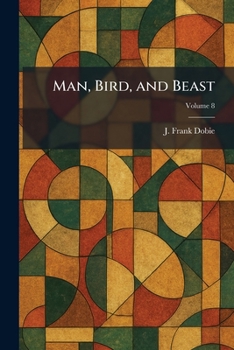
Man, Bird, and Beast

Select Format
Select Condition 
Book Overview
"Man, Bird, and Beast" is a captivating collection of Southwestern folklore and regional legends, edited by the renowned folklorist J. Frank Dobie. As a significant entry in a celebrated series of folklore publications, this work brings together a diverse array of stories, anecdotes, and myths that explore the deep-seated relationship between humanity and the natural world in the American frontier.
The volume features a wide range of accounts concerning local wildlife, avian lore, and the rugged experiences of pioneers and cattlemen. From tall tales about clever animals to the superstitious beliefs of early settlers, the contributors delve into the rich oral traditions that shaped the cultural identity of Texas and the surrounding territories. Dobie's curation highlights the unique humor and gritty realism of life on the range, capturing the authentic voices of ranch hands, storytellers, and keen observers of the wilderness.
This anthology serves as an essential record of vanishing traditions and historical narratives from the early 20th century. "Man, Bird, and Beast" remains a vital resource for readers interested in regional history, mythology, and the preservation of the vibrant narratives that define the spirit of the American Southwest.
This work has been selected by scholars as being culturally important, and is part of the knowledge base of civilization as we know it. This work was reproduced from the original artifact, and remains as true to the original work as possible. Therefore, you may see the original copyright references, library stamps (as most of these works have been housed in our most important libraries around the world), and other notations in the work.
This work is in the public domain in the United States of America, and possibly other nations. Within the United States, you may freely copy and distribute this work, as no entity (individual or corporate) has a copyright on the body of the work.
As a reproduction of a historical artifact, this work may contain missing or blurred pages, poor pictures, errant marks, etc. Scholars believe, and we concur, that this work is important enough to be preserved, reproduced, and made generally available to the public. We appreciate your support of the preservation process, and thank you for being an important part of keeping this knowledge alive and relevant.
Customer Reviews
ThriftBooks ® and the ThriftBooks ® logo are registered trademarks of Thrift Books Global, LLC
