


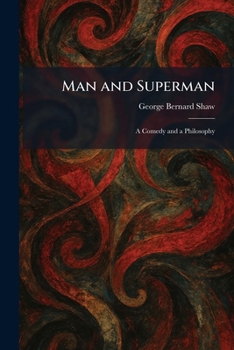
Man and Superman: A Comedy and a Philosophy

"Man and Superman. A Comedy and a Philosophy" is one of George Bernard Shaw's most ambitious and intellectually rigorous works, blending sharp-witted social satire with a profound exploration of human evolution. The drama follows the intellectual and romantic tug-of-war between Jack Tanner, a wealthy revolutionary, and Ann Whitefield, a woman who embodies the relentless power of the "Life Force." Through their interactions, Shaw deconstructs the traditional Victorian notions of courtship and gender roles.
A defining feature of this work is the extended third-act dream sequence, often performed independently as "Don Juan in Hell." In this sequence, characters engage in a spirited philosophical debate in the afterlife, exploring the destiny of the human race and the concept of the "Superman"-an evolved being capable of transcending historical and moral limitations. Shaw uses the framework of a drawing-room comedy to deliver a powerful critique of contemporary politics, marriage, and morality.
As a masterpiece of modern drama, "Man and Superman. A Comedy and a Philosophy" remains a vital text for its brilliance in dialogue and its enduring relevance to discussions on ethics and social progress. It serves as a testament to Shaw's unique ability to merge entertainment with high-concept philosophical inquiry.
This work has been selected by scholars as being culturally important, and is part of the knowledge base of civilization as we know it. This work was reproduced from the original artifact, and remains as true to the original work as possible. Therefore, you may see the original copyright references, library stamps (as most of these works have been housed in our most important libraries around the world), and other notations in the work.
This work is in the public domain in the United States of America, and possibly other nations. Within the United States, you may freely copy and distribute this work, as no entity (individual or corporate) has a copyright on the body of the work.
As a reproduction of a historical artifact, this work may contain missing or blurred pages, poor pictures, errant marks, etc. Scholars believe, and we concur, that this work is important enough to be preserved, reproduced, and made generally available to the public. We appreciate your support of the preservation process, and thank you for being an important part of keeping this knowledge alive and relevant.
Customer Reviews
ThriftBooks ® and the ThriftBooks ® logo are registered trademarks of Thrift Books Global, LLC
