


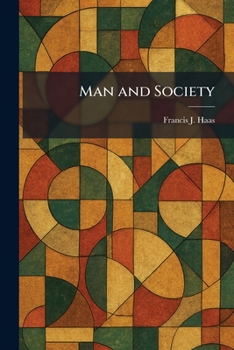
Man and Society

Select Format
Select Condition 
Book Overview
"Man and Society" offers a comprehensive examination of social science and ethics through the lens of human dignity and social responsibility. Written by Francis J. Haas, this foundational work explores the fundamental relationships that define human existence, analyzing the interconnected roles of the individual, the family, and the state within a modern framework.
The book systematically addresses the moral and structural components of a healthy society. Haas investigates the ethical foundations of property, the rights of labor, and the necessity of the living wage, grounding his sociological observations in deep-seated principles of justice. By evaluating the challenges facing industrial civilization, the author provides a rigorous framework for promoting the common good and protecting the rights of all citizens.
Students and scholars of sociology, political science, and religious history will find "Man and Society" to be an enduring contribution to social thought. It serves as an essential bridge between classical ethical theory and contemporary social policy, emphasizing the primacy of the human person in the face of evolving economic and political systems. This insightful study remains a significant text for anyone interested in the intersection of social ethics and community organization.
This work has been selected by scholars as being culturally important, and is part of the knowledge base of civilization as we know it. This work was reproduced from the original artifact, and remains as true to the original work as possible. Therefore, you may see the original copyright references, library stamps (as most of these works have been housed in our most important libraries around the world), and other notations in the work.
This work is in the public domain in the United States of America, and possibly other nations. Within the United States, you may freely copy and distribute this work, as no entity (individual or corporate) has a copyright on the body of the work.
As a reproduction of a historical artifact, this work may contain missing or blurred pages, poor pictures, errant marks, etc. Scholars believe, and we concur, that this work is important enough to be preserved, reproduced, and made generally available to the public. We appreciate your support of the preservation process, and thank you for being an important part of keeping this knowledge alive and relevant.
Customer Reviews
ThriftBooks ® and the ThriftBooks ® logo are registered trademarks of Thrift Books Global, LLC
