


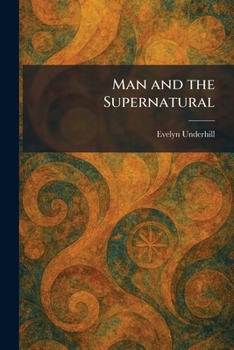
Man and the Supernatural

Select Format
Select Condition 
Book Overview
"Man and the Supernatural" is a profound exploration of the human encounter with the divine and the enduring presence of the transcendent in everyday life. Written by the renowned spiritual teacher Evelyn Underhill, this work delves into the various ways in which the supernatural permeates human existence and consciousness. Underhill examines the historical and psychological evidence for religious experience, arguing that the supernatural is not a remote abstraction but a living reality that actively shapes the human soul.
The book investigates the complex relationship between the natural world and the transcendent, exploring themes of prayer, worship, and the mystical union. Through her characteristic blend of scholarly insight and spiritual sensitivity, Underhill provides a framework for understanding how finite beings can relate to the infinite. "Man and the Supernatural" remains an essential text for those interested in the philosophy of religion, the nature of belief, and the enduring quest for spiritual truth. It offers a compelling defense of the supernatural against purely materialistic interpretations of reality, inviting readers to consider the deeper dimensions of human consciousness and the divine presence within the world.
This work has been selected by scholars as being culturally important, and is part of the knowledge base of civilization as we know it. This work was reproduced from the original artifact, and remains as true to the original work as possible. Therefore, you may see the original copyright references, library stamps (as most of these works have been housed in our most important libraries around the world), and other notations in the work.
This work is in the public domain in the United States of America, and possibly other nations. Within the United States, you may freely copy and distribute this work, as no entity (individual or corporate) has a copyright on the body of the work.
As a reproduction of a historical artifact, this work may contain missing or blurred pages, poor pictures, errant marks, etc. Scholars believe, and we concur, that this work is important enough to be preserved, reproduced, and made generally available to the public. We appreciate your support of the preservation process, and thank you for being an important part of keeping this knowledge alive and relevant.
Customer Reviews
ThriftBooks ® and the ThriftBooks ® logo are registered trademarks of Thrift Books Global, LLC
