


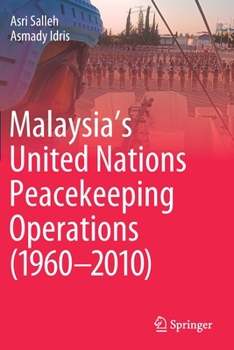
Malaysia's United Nations Peacekeeping Operations (1960-2010)

Select Format
Select Condition 
Book Overview
1Introduction
1.1 Introduction
1.2 Aim
1.3 Literature Review
1.4 Theoretical Framework
1.5 Scope of the Book
1.6 Structure of the Book
2Theoretical Framework
2.1 Introduction
2.2 Contending Mainstream International Relations Theories
2.2.1 Liberalism - Constructivism - Realism
2.3 Analytical Framework
2.3.1 International System and State's Foreign Policy: A Neoclassical Realist Perspective
3 Structure and Process
3.1 Introduction
3.2 UNPKO as A Conflict-Resolution Mechanism
3.3 Malaysia's UNPKO: Structure and Process
3.4 Malaysia's Foreign Policy Posture vis-?-vis UNPKO
3.4 Conclusion4 Systemic-External Pressures and Malaysia's UNPKO
4.1 Introduction
4.2 Power Rivalry vis-?-vis UNPKO
4.3 Voting Pattern of Permanent Members of UNSC via-a-vis UNPKO
4.4 Geostrategic Milieu of UNPKO4.5 Impact of UNPKO to the International System
5 Domestic-Internal Pressures and Malaysia's UNPKO
5.1 Introduction
5.2 Malaysian Prime Ministers and Peacekeeping
5.3 Conclusion
6 Malaysia's UNPKO in the Cold War and Post-Cold War Eras
6.1 Introduction6.2 Malaysia's UNPKO during the Cold War and Post-Cold War Era
6.4 Conclusion
7 The Interplay of Systemic-Domestic Pressures of Malaysia's UNPKO
7.1 Introduction
7.2 Malaysian Prime Ministers and UNPKO7.3 Conclusion
8 Conclusion
8.1. Empirical Findings
8.2. Theoretical Findings and Reflections on Neoclassical Realism Analytical Framework
8.3. Implications for Future Research
Bibliography
Appendices
On the Universiti Teknologi MARA (UiTM)
On the University Malaysia Sabah (UMS)
On the Authors
Index
Customer Reviews
ThriftBooks ® and the ThriftBooks ® logo are registered trademarks of Thrift Books Global, LLC
