


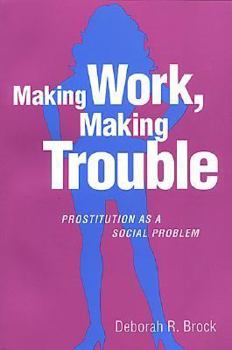
Making Work, Making Trouble: Prostitution as a Social Problem
No Customer Reviews

Why have our efforts to 'clean up' prostitution failed? Even new programs, such as 'John Schools' for customers and training in life skills for service providers, have been ineffective. Deborah Brock asks if our approach to prostitution is fundamentally flawed. We generally think of it as a social problem, but prostitutes see it as a work relation. Anti-prostitution campaigns and attempts to regulate the sex trade have been made and re-made over the past few decades. In the 1970s and 1980s urban development and new policing strategies displaced workers from established prostitution strolls. Movements for social and sexual liberation turned the business of selling sex into a complex political issue. The Canadian state was confronted with a range of regulatory approaches, advocated by competing interest groups. Deborah Brock examines how prostitution in Canada has been produced as a social problem. Contending that 'social problems do not exist objectively,' Brock interprets the role of various actors in mounting the urban sex trade spectacle: the media, feminist organizations, rights advocates, residents' groups, and state agents and agencies such as the police, politicians, the courts, and government commissions. Making Work, Making Trouble is the first critical survey of prostitution in Canada. It provides much needed context to all groups enmeshed in the melTe over territory and rights and should become a standard source in Canadian criminology.
Format:Paperback
Language:English
ISBN:0802079350
ISBN13:9780802079350
Release Date:August 1998
Publisher:University of Toronto Press, Scholarly Publishing Division
Length:256 Pages
Weight:0.70 lbs.
Dimensions:9.0" x 0.6" x 6.0"
Customer Reviews
0 rating
Copyright © 2026 Thriftbooks.com Terms of Use
| Privacy Policy | Do Not
Sell/Share My Personal Information | Cookie Policy | Cookie Preferences | Accessibility Statement
ThriftBooks® and the ThriftBooks® logo are registered trademarks of Thrift Books Global, LLC
ThriftBooks® and the ThriftBooks® logo are registered trademarks of Thrift Books Global, LLC
