


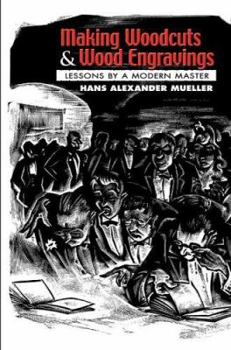
Making Woodcuts and Wood Engravings: Lessons by a Modern Master


An indispensable guide to creating woodcut masterpieces, this volume offers instructions ranging from using the simplest strokes to making intricate multicolor print blocks. Detailed, easy-to-follow... This description may be from another edition of this product.
Format:Paperback
Language:English
ISBN:0486448533
ISBN13:9780486448534
Release Date:July 2006
Publisher:Dover Publications
Length:112 Pages
Weight:0.44 lbs.
Dimensions:9.5" x 0.5" x 6.3"
Customer Reviews
1 rating
Good How-I-Do-it book on wood relief printmaking
Published by Thriftbooks.com User , 18 years ago
An excellent introduction to woodcut and wood engraving. One potential problem with all art How-To books is that the reader's impression of the book is often based on how much they like the author's own examples in the book. If the reader is impressed with those examples, or with the author's work in general, the book will rise in the reader's estimation. This book was written in 1945, when, for obvious reasons, western printmakers were not likely to look to Japan for inspiration or helpful advice. Whatever the reason, Mr. Mueller's work as shown here is solidly embedded in mid-twentieth-century western traditions of block printing and illustration; his draftsmanship is unquestionable and his compositions are powerful. However, with a few exceptions, he doesn't move beyond the established German-Expressionist look of western woodcuts, even when his medium is wood engraving. His engravings appear to be slab-side woodcuts with subtler shading. His wood engravings look like woodcuts. The exceptions to the heavy, dark traditional woodcut look of most of his work are the utilitarian how-to spot illustrations he did for the instructional chapters: how to hold the knife, how to ink the block, etc. They are light, loose and charming. Another problem area is color. The color woodcuts included in this book are in the western style, and generally unimpressive. So if you can set aside prejudices for or against western-style relief prints, this book is a good introduction to the tools and methods of woodcut and wood engraving. Then, after finding out the basics, I can recommend Rebecca Salter's Japanese Woodblock Printing for a different approach. This approach uses some of the same tools, more specific types of wood, and a more individualized impression process to yield prints that are as subtle and detailed as lithographs or serigraphs. Another good source is George Walker's The Woodcut Artist's Handbook, which, like this one, treats of both woodcut and wood engraving, but includes modern examples. Among the examples are period pieces as well as the work of modern printmakers working in different idioms.
Copyright © 2026 Thriftbooks.com
Terms of Use | Privacy Policy | Do Not Sell/Share My Personal Information | Cookie Policy | Cookie Preferences | Accessibility Statement
ThriftBooks ® and the ThriftBooks ® logo are registered trademarks of Thrift Books Global, LLC
ThriftBooks ® and the ThriftBooks ® logo are registered trademarks of Thrift Books Global, LLC
