


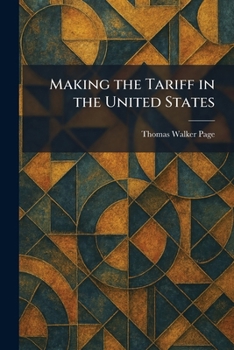
Making the Tariff in the United States

Select Format
Select Condition 
Book Overview
"Making the Tariff in the United States" is a comprehensive and authoritative analysis of the administrative and legislative processes involved in shaping American trade policy. Written by Thomas Walker Page, an esteemed economist and former chairman of the United States Tariff Commission, this work examines the intricacies of tariff-making, advocating for systematic methods and expert investigation over purely political negotiation.
The book explores the historical evolution of customs duties, the economic impact of protectionist measures, and the structural challenges inherent in drafting effective trade legislation. Page provides a detailed critique of the methods used by Congress to determine rates, emphasizing the need for a non-partisan, scientific approach to commercial policy. By dissecting the machinery of the tariff system, the work sheds light on the delicate balance between domestic industrial interests and international economic relations.
This study remains a significant resource for those interested in the history of fiscal policy, economic governance, and the institutional frameworks that have governed American commerce. It offers a clear-eyed look at the technical difficulties of regulating trade and serves as an essential historical reference for understanding the development of 20th-century economic law.
This work has been selected by scholars as being culturally important, and is part of the knowledge base of civilization as we know it. This work was reproduced from the original artifact, and remains as true to the original work as possible. Therefore, you may see the original copyright references, library stamps (as most of these works have been housed in our most important libraries around the world), and other notations in the work.
This work is in the public domain in the United States of America, and possibly other nations. Within the United States, you may freely copy and distribute this work, as no entity (individual or corporate) has a copyright on the body of the work.
As a reproduction of a historical artifact, this work may contain missing or blurred pages, poor pictures, errant marks, etc. Scholars believe, and we concur, that this work is important enough to be preserved, reproduced, and made generally available to the public. We appreciate your support of the preservation process, and thank you for being an important part of keeping this knowledge alive and relevant.
Customer Reviews
ThriftBooks ® and the ThriftBooks ® logo are registered trademarks of Thrift Books Global, LLC
